Benefits of Fat Grafting to the Face and How Long Results Last
By Tseng Plastic Surgery
A facial-volume treatment can use your own tissue and still take months to settle. The benefits of fat grafting to the face include restoring volume with fat harvested from another area of your body, with results that may last for many years. Some transferred fat is absorbed during healing, so the final contour takes time to emerge.
It’s natural to compare facial fat grafting with injectable fillers. Both can soften hollows and restore facial volume, but fat grafting harvests and transfers tissue, while fillers offer a nonsurgical option. That difference affects recovery, longevity, and which approach may suit your preferences.
This article explains how facial fat grafting works, where it can restore volume, and what influences a natural-looking result. You’ll also learn how its longevity compares with fillers, what recovery may involve, and why healing and weight stability matter when considering this longer-term approach.
Key Takeaways
- Fat grafting can restore volume in areas such as the cheeks, temples, and under-eyes using fat taken from your own body.
- Skin quality, available donor fat, overall health, and stable weight all help shape candidacy and the potential result.
- Plan for swelling and bruising in both the face and the donor area; many patients return to normal routines within 7-10 days.
- Fat transfer addresses volume, while significant jowling or excess skin may call for a lifting procedure instead of, or alongside, volume restoration.
What Is Autologous Fat Grafting Face Treatment?
Autologous facial fat grafting transfers a patient’s own fat to areas that have lost volume. The process involves harvesting fat from elsewhere on the body and placing it to restore facial contours.
How Facial Fat Grafting Works
First, liposuction removes fat, often from the abdomen or thighs. The harvested tissue is then processed and placed in selected facial areas. Surgeons use small amounts at different depths to build volume gradually rather than create one concentrated deposit.
This approach matters when age-related volume loss makes cheeks or temples appear hollow. Facial changes may begin in the mid to late twenties, while many people notice volume loss after their 30s or 40s. The aim is balanced rejuvenation that works with existing facial structure.
Facial Areas Treated With Fat Grafting
Common treatment areas include the cheeks, temples, under-eye hollows, nasolabial folds, marionette lines, chin, and jawline. Depending on the contours being addressed, fat may also restore volume around the nostrils, forehead, or lips.
Each area contributes differently to facial balance. Adding cheek volume, for example, can soften a hollow appearance, while filling under-eye depressions can reduce shadowing. A treatment plan identifies where volume is needed instead of treating every hollow or line the same way.
Procedure, Recovery, and Treatment Costs
The procedure combines fat harvesting, processing, and facial placement, typically in an outpatient setting under local anesthesia or light sedation. Mild swelling and bruising commonly last about a week, and many patients return to normal routines within 7-10 days. Recovery also involves the liposuction donor site.
When choosing a facial fat-grafting surgeon, look for specialized surgical training and experience with facial anatomy and fat transfer. Review examples of the surgeon’s work, then discuss your goals, risks, and recovery expectations during a consultation.
Insurance coverage depends on your plan and the reason for treatment; aesthetic volume restoration is generally considered elective. In the United States, cost depends on the case and is provided after a quote request; factors include treatment extent, anesthesia, and facility costs.
Longevity compared with dermal fillers
Facial fat transfer can last many years, while dermal fillers generally need ongoing maintenance. The key difference is that surviving transferred fat can become part of facial tissue, whereas fillers are gradually reabsorbed.
Patients can expect an initial change, followed by settling as the body absorbs some of the grafted fat. The remaining volume may last longer than the effects of temporary fillers.
Fat Retention and Result Longevity
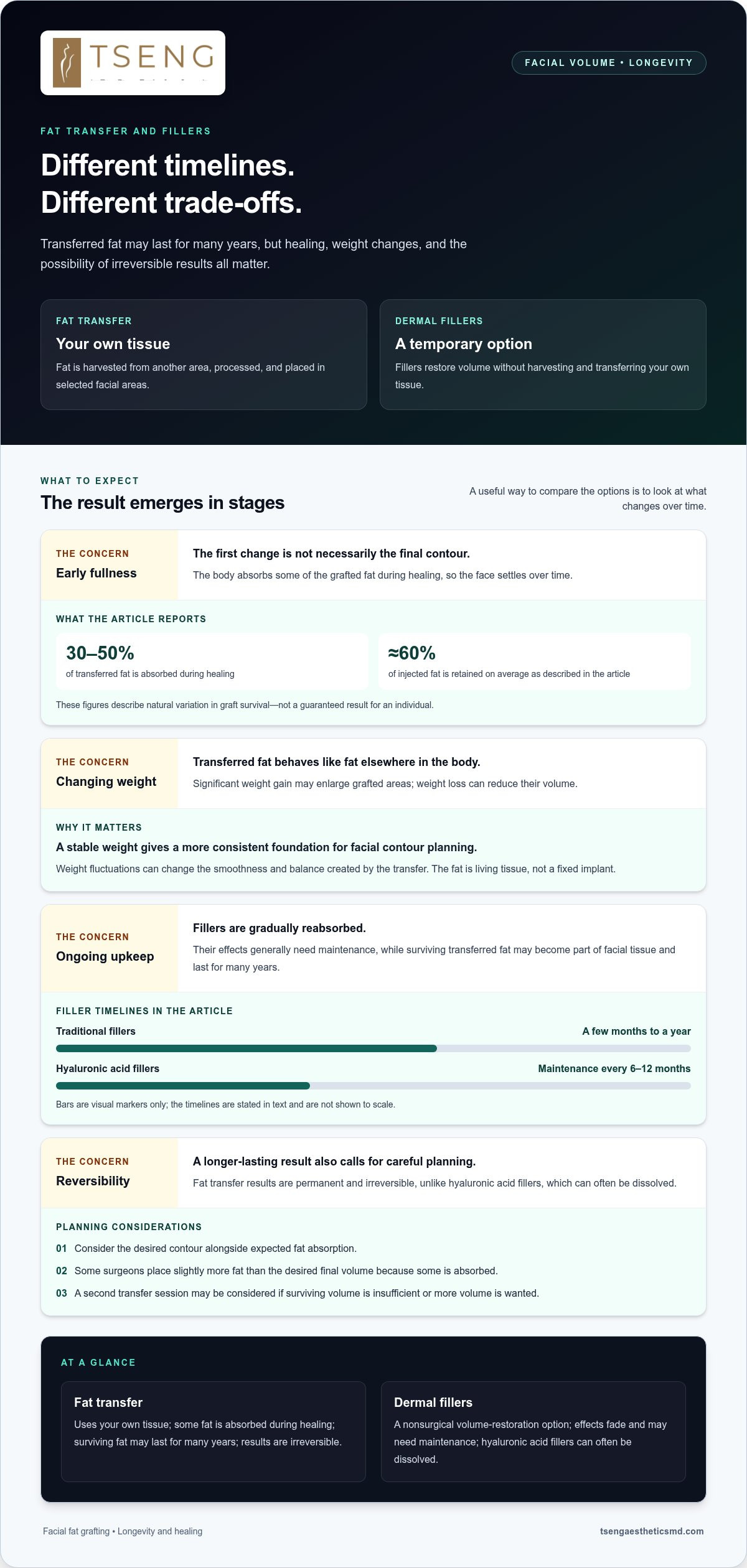
Fat retention describes how much transferred tissue remains after healing, and it shapes the lasting facial contour. The body absorbs about 30 to 50 percent of transferred fat during healing; facial fat grafting retains approximately 60% of the injected fat.
These figures describe natural variation in graft survival, not a guaranteed result for each patient. Once transferred fat establishes a blood supply, it can integrate with surrounding tissue and become a lasting part of the face. Some patients may need another transfer session if the surviving volume is insufficient.
Weight-Related Changes to Results
Transferred fat behaves like fat elsewhere in the body, so weight changes can affect facial volume after treatment. Significant weight gain may enlarge grafted areas, while weight loss can reduce their volume.
This connection matters when comparing a long-term result with a temporary option. A stable weight provides a more consistent foundation for planning facial contours; fluctuations can change the smoothness and balance created by the transfer. The fat is living tissue, not a fixed implant.
Dermal fillers offer a different timeline. Traditional fillers may last from a few months to a year, while hyaluronic acid fillers often need maintenance every 6-12 months. Repeat treatments can preserve a youthful appearance, but they also mean returning for additional injections as the product fades.
Fat transfer is not simply a longer-lasting version of synthetic filler. It involves harvesting and placing tissue, and the final retained volume depends on fat survival. Hyaluronic acid fillers can often be dissolved, while fat transfer results are permanent and irreversible. That difference makes careful planning especially important.
Some surgeons place slightly more fat than the desired final volume because the body absorbs some after treatment. Early fullness therefore doesn’t necessarily reflect the settled contour. As healing progresses, surviving fat can maintain volume for many years. A second session may refine the outcome or add volume.
For a smooth, lasting result, planning considers the requested contour, expected absorption, and weight stability together. If you’re comparing facial rejuvenation approaches, explore facial rejuvenation options as part of your decision.
Recovery, swelling, and bruising
Facial fat grafting involves both fat harvesting and facial injections, so recovery affects the face and donor area. Swelling, bruising, and activity restrictions can influence when work, exercise, and social plans feel manageable.
Swelling and Bruising During Recovery
Swelling and bruising are expected in the face and at the liposuction site, making early appearance different from the settled result. Facial swelling often peaks within three days after the procedure and may take up to 10 days to subside.
Mild facial bruising commonly lasts about a week, while bruising at the donor site can remain visible for 10 to 21 days. A desk-based worker may return after 3-7 days, depending on comfort, while normal routines commonly resume within 7-10 days.
Recovery-Related Side Effects
Temporary swelling and bruising in the face, along with discomfort at the liposuction site, are common recovery effects after fat transfer. Moderate pain and swelling at the donor site may be managed with over-the-counter or prescription medication. Some patients need pain medication for a few days.
Because facial fat grafting is a surgical procedure, recovery is usually more noticeable than recovery from synthetic fillers alone. It is less extensive than conventional facial surgery, but the donor area also needs time to heal after fat harvesting.
Plan your activities around healing, not just how your face looks. Patients may gradually resume physical activity two weeks after surgery, while heavy lifting, bending over, and strenuous exercise should be avoided for at least two to three weeks.
During recovery, sleeping on your back with your head raised on pillows can help protect treated areas. Avoid rubbing or putting pressure on your face, since newly transferred fat needs time to settle into the surrounding tissue.
Follow the specific post-procedure instructions for both the face and donor site. Compression bandages should be worn 24/7, except for shower breaks, for a minimum of two weeks. Liposuction areas often heal in about a week or two, depending on the amount of fat removed.
Many patients feel socially presentable within a couple of weeks, though bruising may remain visible at the donor site. Facial contours continue to settle as swelling subsides, so the early appearance is not the final result. If visible bruising would concern you, avoid scheduling important events during the first few weeks.
Fat transfer is a surgical approach, not a same-day injectable treatment, and recovery planning is part of the decision. People with deep tissue descent, pronounced jowling, or excess skin may need a lifting procedure instead of, or alongside, volume restoration to address the underlying concern.
Fat transfer compared with synthetic fillers
Both fat transfer and synthetic fillers can restore facial volume, but they differ in how material is placed, how recovery unfolds, and how results may change. Start by considering your goal, such as softening cheek hollows or adding volume without repeated maintenance.
Fat grafting involves several steps: a surgeon harvests fat through liposuction, processes it, and places it in facial areas. Fillers are injected directly into selected areas without a separate harvesting step. Fat transfer is therefore a surgical procedure, while filler treatment is injectable.
There is no single procedure-time figure that applies to every facial fat transfer or filler treatment. Fat transfer involves harvesting and processing as well as careful placement. Filler treatment focuses on injection, and its scope depends on the areas being treated. For example, restoring both cheeks with transferred fat involves more procedural stages than injecting one small area.
Recovery also distinguishes the options. Facial fat grafting usually involves more noticeable downtime than injectable fillers alone because both the face and liposuction site can be affected. Filler recovery is generally less involved, although injection sites may still have temporary reactions. If you’re weighing recovery against convenience, consider your planned activities and comfort with visible healing.
Longevity offers another point of contrast. Traditional dermal fillers may last from a few months to a year, and hyaluronic acid fillers often need maintenance every 6-12 months. Surviving transferred fat may last for many years. The difference matters if you prefer periodic adjustments or are considering a longer-lasting change.
Reversibility also matters. Hyaluronic acid fillers can often be dissolved, providing a way to reduce or adjust the result. Fat transfer results are permanent and irreversible, making careful planning of the desired contour especially important, whether you want subtle cheek refinement or broader facial volume restoration.
Neither technique automatically produces a natural appearance. Placement, amount, facial proportions, and treatment area all influence how well added volume blends with existing features. A surgeon plans fat placement across facial tissue, while filler placement targets specific contours. With either approach, treating hollows selectively can preserve balance better than adding volume everywhere.
Consider your priorities together: a surgical process with a longer recovery and potentially lasting volume, or injectable treatments with shorter downtime and periodic maintenance. If volume loss is your main concern, compare the areas you want to restore, the permanence of fat transfer, and your comfort with repeat filler treatments before deciding.
Natural-looking, long-lasting results
Facial fat grafting results develop as swelling resolves and some transferred fat is absorbed. The appearance continues to refine over several months, so early fullness doesn’t reflect the settled contour.
Gradual Appearance of Results
Gradual results reflect healing and how transferred fat survives within facial tissue. During the first days, swelling can make the face look fuller than the eventual result. As swelling subsides and the body absorbs some grafted fat, the contours become clearer.
Final results generally emerge over three to six months after the procedure. This timeline can help you plan photographs and social events, and decide whether you want more volume. A second session may refine the result or add volume once the first transfer has settled.
Natural-Looking Results
A natural appearance depends on restoring volume in proportion to surrounding facial features. For example, added cheek volume should complement the temples and under-eye area rather than make one feature appear isolated.
Fat is placed in small amounts at different depths, allowing the surgeon to shape transitions between treated and untreated areas. Facial fat also contains regenerative cells that may enhance skin texture and tone. The goal is balanced facial volume, not a uniform change across every feature.
Transferred fat can integrate with surrounding tissue after establishing a blood supply. Fat cells that survive may remain part of facial tissue and provide lasting volume, while other cells are absorbed during healing. Weight stability matters because transferred fat behaves like fat elsewhere in the body, and weight fluctuations can change facial fullness.
Distinguish lasting volume from an unchanging appearance. The face continues to age, and natural changes in skin and tissue can affect contours even when grafted fat remains. Fat transfer is permanent and irreversible, unlike hyaluronic acid fillers, which can often be dissolved. That permanence makes measured planning important.
A plastic surgeon considers facial proportions, the areas needing volume, and how much fat is likely to survive. A plan for under-eye hollows, for instance, differs from one addressing the cheeks and temples. Photos taken at several points during the three-to-six-month settling period can help track changes accurately.
If you’re considering a lasting change, schedule a facial rejuvenation consultation to discuss your goals and the contours you’d like to restore.
Tseng Plastic Surgery: Facelift
Tseng Plastic Surgery offers facelift procedures for people whose concerns include facial laxity, jowling, or descended tissues rather than volume loss alone. Fat grafting restores volume, while a facelift addresses sagging. Distinguishing these concerns can clarify which approach aligns with your goals.
For patients seeking facial and neck rejuvenation, the practice also offers a Minimal invasive preservation face and neck lift. Discussing your priorities can help determine whether a lifting procedure addresses your concerns better than volume restoration. The right approach depends on the changes you want to address and your preferences.
If you’re considering facial rejuvenation, contact Tseng Plastic Surgery to discuss your goals or visit tsengaestheticsmd.com.
Choose a Direction That Feels Right for You
The benefits of fat grafting to the face are best considered in relation to your priorities, not an idealized image. Before taking the next step, identify what you’d like to change and what you want to preserve. That distinction can help guide a thoughtful conversation about facial balance and your preferred degree of refinement.
It may also help to consider how you feel about permanence, recovery, and the possibility of ongoing maintenance. These preferences are personal, and naming them clearly gives a consultation a useful starting point. Bring specific concerns, such as a hollow area or a change in facial contour, rather than relying on broad descriptions alone.
Tseng Plastic Surgery can discuss facial rejuvenation options, including whether a lifting approach better fits your concerns. Contact Tseng Plastic Surgery to begin a conversation about your goals. A considered plan starts with what feels natural to you, and that is a meaningful step toward feeling more confident in your choices.
Frequently Asked Questions
What Is Fat Grafting?
Fat grafting transfers a person’s own fat to another area of the body, such as the face. For facial treatment, fat is collected from a donor area, processed, and placed where added volume is desired. Unlike synthetic filler, which is injected without harvesting tissue, fat transfer involves both a donor site and facial treatment areas, so planning accounts for both.
How Long Do Results Last?
Facial fat-transfer results can last many years. Fat cells that survive and integrate with facial tissue create lasting change; other transferred cells are absorbed during healing. Weight stability helps preserve the contour because grafted fat behaves like fat elsewhere in the body. Substantial weight changes may alter facial fullness, as they can affect other areas.
Who Is a Good Candidate?
A good candidate generally has facial volume loss, reasonable skin quality, enough donor fat, good overall health, and a stable weight. Realistic expectations matter because the final contour partly depends on how much transferred fat survives. Someone seeking subtle cheek fullness, for example, may have different needs from someone with substantial loose skin or deep tissue descent.
Why Choose Fat Grafting for Facial Rejuvenation?
People choose fat grafting to use their own tissue to address facial volume loss. Transferred fat can become part of surrounding tissue, and its regenerative cells may enhance skin texture and tone. The approach involves liposuction and surgical recovery, making it different from injectable treatments that do not require fat harvesting.
What Are the Benefits of Facial Fat Grafting?
The benefits of fat grafting to the face include using a person’s own fat to restore volume, with results that may last many years. It can also address several areas in a coordinated plan, such as the temples and cheeks. Some patients value the potential improvement in skin texture and tone. These benefits come with surgery and results that are permanent and irreversible.
What Facial Areas Can Fat Grafting Treat?
Facial fat grafting can add volume to the cheeks, temples, under-eye hollows, lips, chin, and jawline. It may also address nasolabial folds, marionette lines, the forehead, and hollows around the eyes. The areas selected depend on where volume loss or contour concerns appear. For example, hollow temples and a flattened cheek area can be considered together when planning facial balance.
How Does Facial Fat Grafting Compare With Dermal Fillers?
Fat grafting requires liposuction, processing, and facial placement, while dermal fillers are injected directly. Fat transfer involves more noticeable recovery, and surviving fat can last for many years. Traditional fillers often last from a few months to a year, with hyaluronic acid fillers commonly needing maintenance every 6-12 months. Hyaluronic acid fillers can often be dissolved; fat transfer is permanent and irreversible.
What Are the Risks and Complications of Facial Fat Grafting?
Expected recovery effects include swelling and bruising in the face and donor area. Some transferred fat is absorbed during healing, which may leave less volume than initially placed and sometimes lead to another session for refinement. Weight changes can also alter the appearance of grafted areas. Because the result is permanent and irreversible, treatment planning should account for the desired contour and the possibility of fat absorption.

