Do Collagen Supplements Work for Skin? Supplements vs. Collagen-Stimulating Injectables
By Tseng Plastic Surgery
If a collagen powder and collagen stimulating injectables both promise to support skin, should you expect them to work the same way? No. Oral collagen supplements and injectable treatments are distinct approaches, and evidence for one cannot establish the effectiveness of the other.
The claims can be confusing because “collagen” may refer to a supplement you swallow, a material used in some fillers, or a medical treatment intended to prompt the body’s own collagen response. Research on supplements is still developing, while injectable treatments have different mechanisms, considerations, and timelines. Neither should be judged by marketing language alone.
This article explains what research can and can’t tell us about oral collagen supplements, how collagen-stimulating treatments differ, and why the two aren’t interchangeable. It also offers practical questions to raise in a personalized aesthetic consultation, from your goals and expectations to the potential benefits and considerations of treatment. At Tseng Plastic Surgery, education and individualized care help frame those conversations, with attention to balanced, natural-looking outcomes.
Key Takeaways
- Collagen supplement research often measures skin hydration, elasticity, and wrinkle appearance. Distinguish these specific findings from broad marketing promises.
- Compare how each option is used, its intended action, the evidence behind it, and whether clinician involvement is part of the process.
- Use a simple evidence check: examine the claim, study design, supplement formulation, measured outcome, limitations, and safety information.
- Collagen stimulating injectables are one possible part of non-surgical aesthetic care. Suitability depends on your concerns, goals, health history, and clinical assessment.
- Bring your supplement use and questions to a personalized consultation to discuss options and set realistic expectations for balanced, natural-looking care.
Do Collagen Supplements Work for Skin? Start With What They Are
Collagen supplements may affect some skin measures, but the evidence is not definitive, and results can vary. Collagen is a structural protein found in skin and other tissues. In skin, it contributes to the framework that supports firmness and structure. It is only one influence on skin appearance over time. Aging also reflects factors such as genetics and environmental exposure.
The word “collagen” can describe different things: a protein in a supplement, a material used in some fillers, or an injectable intended to stimulate the body’s own collagen response. These aren’t interchangeable treatments, and evidence about one doesn’t establish the effects of another. For an overview of collagen’s structure and biological roles, see Collagen.
What does an oral collagen supplement contain?
Many oral products contain hydrolyzed collagen peptides, which are collagen broken down into smaller peptide components. Labels may also list flavorings or added nutrients. The complete formulation matters when you assess a product claim.
An ingredient list tells you what a supplement contains, not whether it has been shown to improve skin. Look for research on the specific formulation and on observable outcomes such as hydration, elasticity, or wrinkle appearance. A claim about “supporting collagen” alone doesn’t establish a visible benefit, how large a change might be, or whether the findings apply to every product in the category.
What does collagen-stimulating injectable mean?
Collagen-stimulating injectables are treatments administered by injection with the intended purpose of prompting the body’s collagen response; they don’t all contain collagen. This describes a treatment category, not a single ingredient or product. Some injectable fillers may be described as collagen-based, while a collagen biostimulator is intended to encourage a biological response rather than simply supply collagen as an ingredient.
Poly-L-lactic acid, or PLLA, is one example studied for its collagen-stimulating effects. That research example isn’t evidence about oral supplements, nor does it mean every injectable works the same way. Injectable treatments act locally through a clinical procedure, while supplements are taken by mouth. Their use, intended action, evidence, and considerations differ.
That distinction matters when evaluating claims. A study of an injectable can’t show that a supplement will produce the same outcome, and a supplement study can’t establish the effects of a procedure. Assess each option on its own evidence: what was studied, which outcomes were measured, and how closely the research applies to the person considering treatment. A discussion of your skin goals and medical history can help put those differences in context without treating either option as a universal answer.
How Collagen Supplements Could Affect Skin, and What Studies Measure
Researchers have proposed that collagen peptides from oral supplements could influence processes involved in skin structure. They may supply components the body uses to make proteins or signal cells involved in collagen production. This biological rationale is not proof that a supplement reaches the skin in a particular form or produces a visible change. To assess whether a product helps, focus on what human studies actually measured.
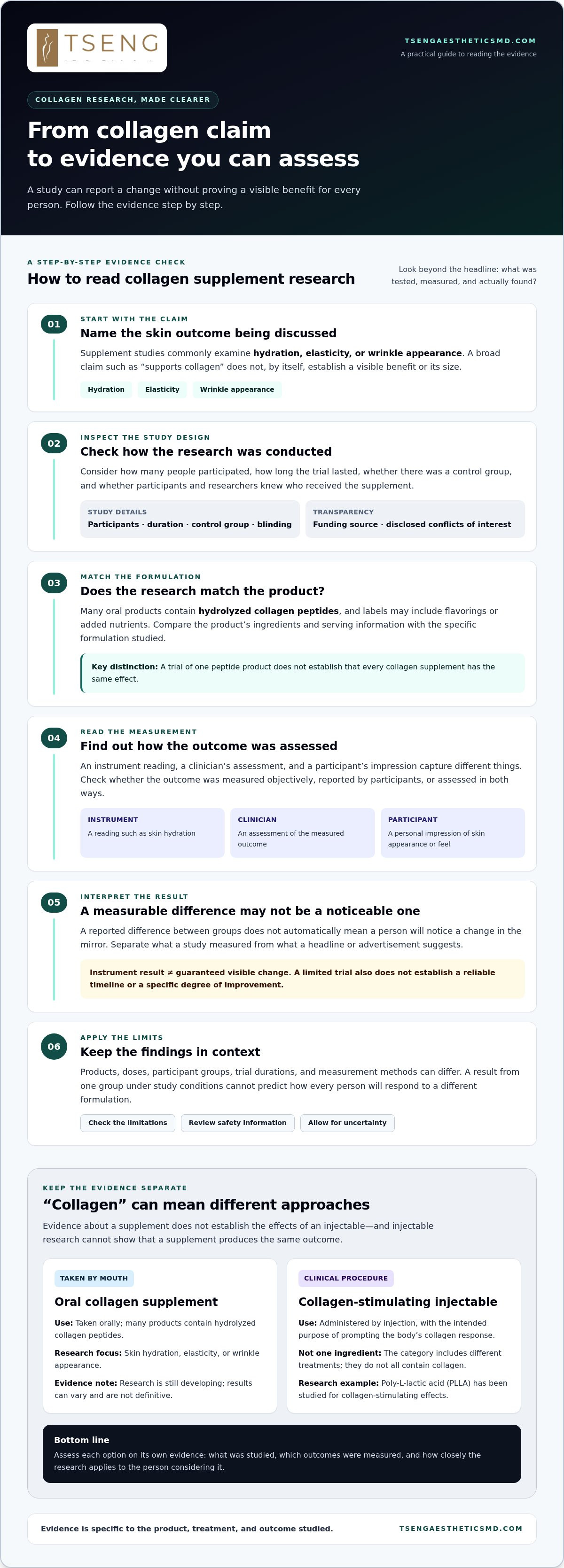
Trials commonly examine skin hydration, elasticity, or wrinkle appearance. These measures offer different kinds of information. An instrument reading, a clinician’s assessment, and a participant’s impression each capture something different. Even when a study reports a measurable difference between groups, that doesn’t automatically mean a person will notice the change in the mirror.
How to read collagen supplement research
Start with the study, not just its headline. Consider how many people took part, how long the trial lasted, whether it had a control group, and whether participants and researchers knew who received the supplement. Check who funded the research and whether conflicts of interest were disclosed. These details help you judge how confidently to interpret the findings.
Next, check the formulation. A trial of one specific peptide product doesn’t establish that every collagen supplement has the same effect. Compare the product’s ingredients and serving information with those studied. Then check whether outcomes were measured objectively, reported by participants, or assessed both ways. For example, a result on a hydration instrument isn’t the same as participants saying their skin looked or felt better.
Why results may not translate to every person
Findings can differ because products, doses, participant groups, trial durations, and measurement methods differ. A result from a particular group under study conditions can’t predict how every person will respond to a different formulation. A limited trial also doesn’t establish a reliable timeline or a specific degree of improvement.
Skin appearance has multiple influences, so a change in hydration or elasticity shouldn’t be assumed to address every concern. Sun exposure, natural variation, and other aspects of health and skin care may also be relevant. Separate what a study observed from what an advertisement implies, and allow for uncertainty where the evidence doesn’t answer a question.
Findings about injectable PLLA cannot establish whether oral collagen supplements improve skin, because the intervention, route, and evidence being studied are different. Research on collagen stimulating injectables shouldn’t be used as proof for a supplement, or vice versa. If you’re weighing aesthetic options, a personalized discussion can connect the evidence to your concerns and goals. A personalized aesthetic consultation is one setting for that conversation.
Supplements vs. Collagen-Stimulating Injectables: What Is the Real Difference?
Oral supplements and injectable treatments are both discussed in relation to collagen, but that shared word doesn’t make them equivalent. One is taken by mouth; the other is administered through a clinical procedure. Their intended actions, evidence, and considerations differ, so neither should be treated as a universal substitute for the other.
How oral supplements differ from injectable treatments
Oral collagen supplements are taken by mouth, and studies usually examine a particular product or peptide formulation. Judge proposed skin effects against the outcomes measured in that research. Injectable treatments, by contrast, are delivered into selected areas following an in-person clinical assessment. The treatment plan and its purpose depend on the individual’s concerns and clinical evaluation.
Some collagen stimulating injectables are intended to prompt the body’s collagen response. Poly-L-lactic acid (PLLA), for example, has been studied as an injectable material, but evidence about PLLA doesn’t establish what an oral supplement does. A supplement shouldn’t be expected to reproduce the effects of a procedure. The route, intervention, and research questions are different.
Comparison
Oral collagen supplements
Route: Taken by mouth.
Intended action: Studied for possible effects associated with skin measures; the proposed rationale does not prove a visible result.
Evidence type: Research on specific formulations may measure outcomes such as hydration, elasticity, or wrinkle appearance.
Clinician involvement: Not administered as a procedure, though discussing supplement use with an appropriate clinician can help account for health history and other products taken.
Collagen-stimulating injectable treatments
Route: Delivered by injection as a clinical treatment.
Intended action: Intended to stimulate a collagen response, depending on the injectable material.
Evidence type: Clinical research and product-specific evidence; findings for one material shouldn’t be generalized to all injectables.
Clinician involvement: Requires an in-person assessment and administration as a procedure.
What the evidence can, and cannot, compare
A fair comparison requires direct head-to-head research that evaluates both interventions using relevant, comparable outcomes. When evidence comes from separate studies, differences in participants, methods, and measured results make a simple “which works better” conclusion unreliable.
Manufacturer-reported outcomes can describe findings associated with a specific injectable product, but they aren’t the same as independent comparative research against supplements. Likewise, a study of PLLA applies to that material and the conditions studied, not automatically to other injectable materials or oral products. Results depend on the intervention, study design, and individual factors.
These distinctions are useful when considering broader facial-rejuvenation goals, where treatment choices may extend beyond either category. The modern facelift guide offers additional context on approaches to facial rejuvenation.
How to Evaluate Skin Claims, Safety, and Personal Suitability
Skin-related claims can sound persuasive while leaving out what matters: what was studied, what changed, and whether the findings apply to you. A short evidence check can help you assess supplement claims, while a clinical conversation can clarify considerations involved in injectable treatment. Neither supplements nor collagen stimulating injectables are automatically suitable for every person.
Questions to ask about supplement claims
Look beyond the front label. Check the full ingredient list and serving information, then see whether the evidence refers to that specific formulation or to collagen supplements as a broad category. Testimonials describe individual experiences, but they can’t replace transparent research citations.
- Claim: What specific skin change does the product say it supports? A broad phrase such as “beauty from within” is less informative than a clearly stated outcome.
- Study: Is a study cited, and does it examine people using the product or formulation being promoted?
- Formulation: Do the ingredients and serving information match those studied?
- Outcome: Was the result hydration, elasticity, wrinkle appearance, or another measure? How was it assessed?
- Limitations: Consider the study’s participants, methods, duration, and whether its results can reasonably apply beyond that group.
- Safety: Review the product’s safety information and discuss supplement use, medications, and relevant health history with an appropriate clinician.
This process won’t determine what’s right for you, but it can separate evidence about a particular product from broad marketing language. If you have health concerns or take medications, bring the supplement label or ingredient list to a qualified clinician so those details can be considered in context.
What a thoughtful injectable assessment considers
An injectable treatment calls for a different kind of evaluation. The clinician needs to understand the concern you want to address, your medical history, and the degree of change you hope to achieve. Assessment also helps clarify which options may be relevant, their limitations, and whether a procedure aligns with your goals.
Ask for a clear explanation of the specific treatment being considered, its product-specific risks, realistic outcomes, and remaining uncertainties. Evidence for one injectable material shouldn’t be assumed to apply to another. A careful conversation should make room for questions and for deciding that treatment isn’t the right next step.
At Tseng Plastic Surgery, a personalized consultation is an opportunity to discuss aesthetic goals and understand individualized options, with an emphasis on balanced, natural-looking care. Discuss your goals in a personalized aesthetic consultation.
Where Collagen-Stimulating Injectables Fit in Personalized Aesthetic Care
Understanding how collagen supplements and injectable treatments differ can clarify your choices, but it can’t determine which approach, if any, fits your needs. The next step depends on the concern you want to address, your goals, medical history, and a clinical assessment. Collagen stimulating injectables are one possible part of non-surgical aesthetic care, not a substitute for supplements or a guaranteed solution for every skin concern.
A consultation is an opportunity to look beyond a single ingredient or treatment category and consider your overall aesthetic priorities. You might be seeking a subtle change in facial appearance, have questions about skin quality, or want to understand whether a procedure aligns with your preferences. The purpose is to explore options thoughtfully, not to assume treatment is necessary.
When an aesthetic consultation may help
General information can explain how supplements are studied, but it can’t account for your individual health history or clarify which aesthetic options may be relevant to your concern. A personalized discussion can turn broad claims into a practical conversation about goals, possible approaches, and trade-offs.
Describe what you’d like to look different and what you’d prefer to preserve. Be open about your concerns, your comfort with a gradual or more noticeable change, and any limits that matter to you. Recommendations and outcomes are individual; a consultation should set realistic expectations rather than promise a particular result.
How to approach the conversation with confidence
Bring questions about the evidence behind a recommendation, treatment-specific risks, expected recovery, and alternatives. Share relevant medical history and any supplements or medications you use. These details help make the discussion more complete and give the clinician context for considering suitability. You can also ask what a treatment is intended to address and what it may not change.
Dr. Mark H. Tseng has more than 20 years in practice, and Tseng Plastic Surgery emphasizes individualized care and balanced, natural-looking results. That patient-centered approach means discussing your personal vision alongside clinical considerations, with room to understand options before making a decision. Not every concern calls for an injectable, and a thoughtful plan should reflect the person, not just the treatment category.
For broader context on how surgical and non-surgical approaches differ, explore this surgical versus non-surgical facelift guide. It can help frame questions about the scope of different approaches without suggesting that one is right for everyone.
If you’d like to discuss your goals and understand personalized options, you’re welcome to schedule a consultation. The conversation can help you consider a next step that feels informed, appropriate, and aligned with your preferences.
Choose a Next Step That Feels Right for You
Understanding the evidence can help you ask better questions, but your next step doesn’t need to be a procedure. You might continue reviewing supplement claims, talk with a clinician about what you take, or explore whether an aesthetic treatment aligns with your priorities. The useful choice is one grounded in your health, preferences, and personal goals.
At Tseng Plastic Surgery, a physician-owned practice, aesthetic care is guided by individual concerns and a commitment to natural-looking, balanced results. Dr. Mark H. Tseng brings more than 20 years in practice to conversations about options, helping patients consider whether collagen stimulating injectables or another approach may be appropriate for them. No treatment can be assumed to suit everyone, and a thoughtful discussion leaves room for questions and reflection.
If you’re ready to explore your options, schedule a consultation to discuss your aesthetic goals. You can take the next step with clarity, at a pace that feels comfortable.
Frequently Asked Questions
Do collagen supplements work for skin?
They may affect some skin measures, but the evidence doesn’t establish a predictable, visible change for everyone. For example, a study may report a measured difference in skin elasticity without showing that participants noticed a meaningful change in appearance. Results also depend on the formulation and study quality. Treat a supplement claim as a reason to examine the research, not as proof that the product will restore skin collagen or replace medical care.
How long does it take for collagen supplements to affect skin?
There’s no dependable timeframe that applies to every collagen supplement or person. A trial’s length tells you how long researchers observed participants, not when an individual can expect to notice a change. If a product cites a timeline, look for the specific study, formulation, and outcome behind that claim. A change recorded by an instrument during a trial, for example, may not be the same as a visible difference you can judge yourself.
Are collagen-stimulating injectables the same as collagen supplements?
No. Supplements are taken orally, while collagen stimulating injectables are administered as clinical treatments and can involve different materials and mechanisms. Evidence about a supplement can’t establish the safety or effects of an injectable, and injectable research doesn’t prove an oral product works. Keep claims specific: ask which intervention was studied, what outcome researchers measured, and whether the evidence applies to the option being discussed.
Can collagen supplements replace injectable treatments?
No. They’re different approaches, so a supplement shouldn’t be expected to reproduce the outcome of an injectable procedure. Likewise, an injectable isn’t a nutritional supplement. If you’re considering either, start with the concern you hope to address and the changes you’d feel comfortable pursuing. A clinician can discuss how your goals, health history, and preferences inform possible options, without assuming that either approach is necessary or right for you.
Are collagen supplements safe for everyone?
No supplement should be assumed to suit everyone simply because it’s sold without a prescription. Ingredients, sensitivities, medications, and personal health circumstances can all matter. Before starting one, read the complete product information and share the label with an appropriate clinician, especially if you take medication or have a health condition. This gives them a chance to consider the specific ingredients in the context of your care.
What should I ask before considering a collagen-stimulating injectable?
Ask what concern the proposed treatment is intended to address, what evidence supports that specific option, and which risks or limitations are relevant to you. You can also discuss realistic outcomes, alternatives, and how your health history affects the assessment. An online testimonial describes one person’s experience, not a personal recommendation. A clinical conversation should help you understand the reasoning behind any proposed approach before you decide whether to proceed.

