How to Improve Jawline Definition With Practical Steps
By Tseng Plastic Surgery
Jawline exercises can engage facial and neck muscles, but they can’t reshape the face on their own. If you’re wondering how to improve jawline definition, consider several practical approaches: posture, hydration, and daily habits may support a more defined appearance, while aesthetic treatments offer other options.
It’s understandable to hope that a few targeted movements will create a sharper contour. Exercises such as neck curl-ups can be part of a routine, but their effects are limited, and technique matters. Choose steps that suit your goals without expecting exercise to change bone structure or redistribute facial fullness.
Learn what jawline exercises can realistically do, how to perform a neck curl-up, and which hydration and dietary choices may help with facial puffiness. You’ll also see how posture, skincare, and aesthetic approaches may contribute, helping you make a more informed choice about the definition you’re seeking.
Key Takeaways
- Set realistic expectations for facial exercises: they can engage muscles, but they won’t reshape your underlying facial structure.
- Use posture and everyday habits to support a more defined-looking jaw and neck.
- Consider whether facial puffiness, rather than jaw shape, is affecting the contour you see.
- Compare temporary appearance-enhancing techniques with nonsurgical options to identify an approach that fits your goals.
Do Jawline Exercises Work?
Jawline exercises can engage facial muscles, but they can’t reshape the face on their own. If you’re considering how to improve jawline definition, treat exercise as one part of a measured routine, not a way to change bone structure.
See a doctor or dermatologist about an unexpected jawline change, especially if it comes with persistent discomfort or visible skin changes. A new contour or symptom needs assessment, not more repetitions.
-
Assess Potential Benefits and Limits
Use jawline exercises to work the muscles around your mouth and jaw area, while keeping expectations modest. A study found that facial exercises performed regularly for 20 weeks led to fuller cheeks and a more youthful appearance, but there’s no scientific evidence that exercises alone sculpt the face’s physical shape. Muscle engagement isn’t the same as changing your underlying facial structure.
-
Combine Exercises With Massage and Posture
Pair gentle jaw movements with a light massage and upright posture. Sweep from the chin along the jawline toward the ears to ease facial tension and encourage fluid drainage; a jade roller is optional. Keep your head aligned over your shoulders instead of jutting forward. These steps may affect tension or puffiness, but they don’t alter bone structure.
-
Progress Gradually and Keep Your Form Controlled
Start with three beginner exercises for 10 repetitions each, three times weekly during weeks 1 to 2. For weeks 3 to 4, increase to 15 repetitions and four days weekly. From week 5 onward, work toward 20 repetitions and five sessions weekly. If you’re deciding how to improve jawline definition, prioritize controlled form and gradual progression over forceful, extended sessions.
-
Notice Jaw Discomfort and Avoid Risky Techniques
Pay attention to how your jaw feels during each movement. Jaw exercises may ease discomfort associated with temporomandibular disorders, but stop if an exercise increases pain. Avoid mewing as a jawline-shaping method: it may contribute to bite or speech problems and affect tooth alignment. Chewing gum doesn’t change jaw shape either.
Hydration and dietary choices for facial puffiness
- Drink water regularly throughout the day, using two liters daily as a general target from the article’s guidance. Adequate hydration supports skin elasticity, but it won’t tighten loose skin or change facial structure. If your cheeks look fuller after waking, compare your appearance at different times rather than expecting one glass of water to make an immediate difference.
- Track meals alongside facial puffiness for several days. Note whether packaged or salty foods coincide with a temporarily fuller appearance, then choose balanced meals and steady hydration. Weight gain can increase facial fullness, while gradual weight changes may alter the jawline’s appearance. Diet can affect bloating and contour, but it can’t reposition the chin or reshape bone.
- Keep bone structure in mind when assessing your profile. Jaw angles, chin projection, facial growth, and natural asymmetry all influence definition. The tongue’s resting position isn’t a reliable way to remodel adult jaw structure. Compare your front and side profiles in consistent lighting, rather than judging changes from one close-up photo.
- Try a gentle five-minute facial massage when puffiness is noticeable. Starting at the chin, sweep along the jawline toward the ears with light pressure; a jade roller is optional. This direction can encourage fluid drainage and ease facial tension. Massage doesn’t remove fat, build collagen, or create lasting structural change.
- Distinguish temporary swelling from features that remain consistent. Take comparison photos at the same time of day and in the same posture, then look for gradual patterns rather than expecting an immediate transformation. If fullness changes with meals or time of day, daily habits may play a part; persistent contour differences often reflect anatomy, including cheek volume and chin projection.
Non-surgical approaches to jawline definition
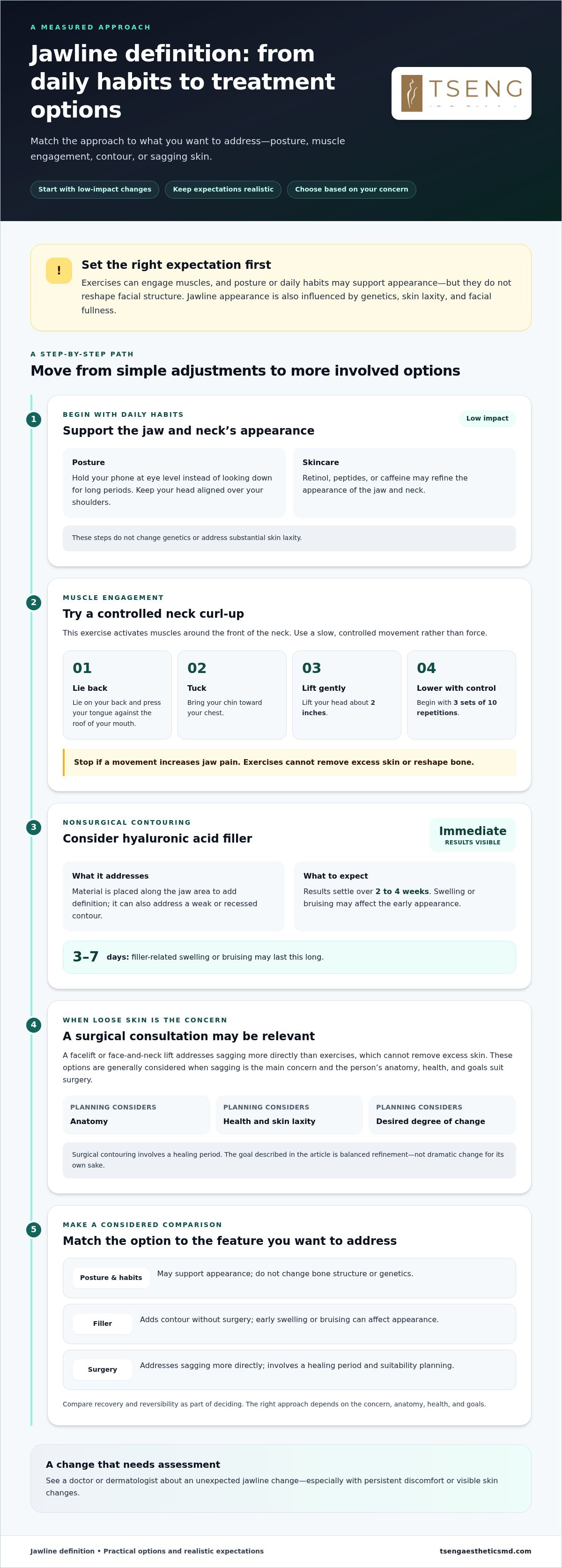
Jawline appearance reflects genetics, skin laxity, posture, and facial fullness, so match each approach to the feature you want to address. Jawline fillers can cause swelling or bruising for 3 to 7 days; surgical contouring involves a healing period. Surgical options include facelift and face-and-neck lift procedures, generally considered when sagging skin is the main concern and a patient’s anatomy, health, and goals suit surgery.
- Start with low-impact changes before considering treatment. Hold your phone at eye level instead of looking down for long periods, and use skincare containing retinol, peptides, or caffeine. These steps may refine the appearance of the jaw and neck, but they won’t change genetics or address substantial skin laxity.
- Try a neck curl-up to activate the muscles around the front of your neck. Lie on your back, press your tongue against the roof of your mouth, and bring your chin toward your chest. Lift your head about 2 inches, then lower it with control. Begin with 3 sets of 10 repetitions.
- Consider nonsurgical treatment when you want contouring without surgery. Hyaluronic acid filler adds definition by placing material along the jaw area; it can also address a weak or recessed contour. Results are visible immediately, then settle over 2 to 4 weeks. Swelling or bruising may affect how the result looks during early recovery.
- Consider a surgical consultation if loose skin or jowls are your primary concern. A facelift or face-and-neck lift addresses sagging more directly than exercises, which can’t remove excess skin. Planning depends on a suitable candidate’s anatomy, health, skin laxity, and desired degree of change. The goal is balanced refinement, not dramatic change for its own sake.
- Compare recovery and reversibility before deciding. Filler-related swelling or bruising may last 3 to 7 days, while surgery requires a longer healing process. Hyaluronic acid filler can usually be dissolved with hyaluronidase within 24 to 48 hours. Surgical changes aren’t reversed this way, so align the approach with your priorities and tolerance for recovery.
How can makeup, hairstyles, or facial hair create the appearance of a sharper jawline?
- Use contour makeup to create a subtle shadow beneath the jaw. Choose a shade that looks natural against your skin, then blend from below the ears toward the chin. Keep the line soft rather than drawing a dark stripe. Check the result in daylight, since strong indoor lighting can make contouring look harsher than intended.
- Blend carefully where the jaw meets the neck. A visible edge can draw attention to the makeup instead of creating a refined contour. Use a clean brush or sponge to soften the transition, then compare both sides in a mirror. If one side looks stronger, adjust lightly instead of adding heavy product across the whole jaw.
- Choose a hairstyle that frames your face in a way you like. Hair tucked behind the ears, for example, reveals the jawline, while face-framing layers can soften its outline. Ask your stylist to consider your natural part and hair texture. The goal is visual balance, not hiding your features or forcing a particular face shape.
- Shape facial hair to create a clean visual boundary. A beard trimmed close along the cheeks and defined beneath the jaw can emphasize the lower face. Keep the neckline neat, and avoid dense growth that blurs the jaw-to-neck transition. Even stubble can create a different outline without changing your anatomy.
- Assess your overall look from the front and side before settling on a routine. Take a photo in consistent lighting, first with your usual hairstyle or facial hair, then with one adjustment. Comparing the images can show whether a softer contour, tucked hair, or cleaner beard line creates the appearance you prefer. Makeup and grooming change visual emphasis, not bone structure—principles that professional esthetician training programs such as 5tbeauty.com teach for enhancing facial balance and features.
Tseng Plastic Surgery: Facelift
Tseng Plastic Surgery offers facelift options for people concerned about sagging skin or jowls rather than temporary puffiness. A facelift may be worth discussing when posture, grooming, and daily habits don’t address the changes you notice. The practice also offers a minimal invasive preservation face and neck lift, a surgical approach to facial and neck rejuvenation.
Start by identifying your priorities: addressing loose skin, refining the lower face, or considering changes to the neck as well. A personalized evaluation can help clarify which approach aligns with your facial features and goals, rather than treating every jawline concern the same way.
Contact Tseng Plastic Surgery to discuss your goals and possible next steps.
Choose a Next Step That Fits Your Goals
Decide what you want to change before choosing a treatment path. Is your focus a softer jawline, loose skin, or a more balanced facial profile? Naming your priorities can make a conversation about how to improve jawline definition more useful and grounded in your preferences.
Tseng Plastic Surgery offers facelift and minimal invasive preservation face and neck lift procedures, as well as liposuction. These are distinct options, so the right discussion starts with the concern you want addressed, not a one-size-fits-all idea of definition. Consider the result you hope to see and what degree of change feels authentic to you.
If you’re ready to explore facial rejuvenation options, contact Tseng Plastic Surgery to begin a conversation. Thoughtful decisions can help you move toward a look that feels balanced and true to you.
Frequently Asked Questions
What factors affect jawline definition, including genetics, body fat, and age?
Genetics influence your jaw shape, chin projection, and where facial fullness sits. Body fat can soften the transition between the jaw and neck, while age-related skin laxity and changes in facial volume can alter the contour over time. Compare your profile in consistent lighting and posture to help distinguish a stable structural feature from a changing soft-tissue outline.
Can weight loss or body-fat reduction make the jawline more defined, and what is a healthy approach?
Weight loss can make the jawline appear clearer when overall facial fullness is part of the concern, but it won’t change bone shape or guarantee a particular contour. Choose gradual, sustainable habits rather than extreme restriction, and assess changes across your whole face and body. If weight or diet decisions involve health concerns, discuss an appropriate plan with a healthcare professional.
Do jaw exercises, chewing gum, or facial exercises improve jawline definition?
Facial exercises may engage muscles, but their effect on jawline definition is uncertain. For a practical test, follow a controlled exercise routine and track comfort and appearance in consistent photos rather than adding forceful repetitions. Stop any movement that causes discomfort, especially if you have jaw pain or clicking.
What cosmetic treatments improve jawline definition, and how do fillers, Botox, and fat-dissolving injections compare?
These treatments address different features. Hyaluronic acid filler adds contour in the jaw area; Botox changes muscle activity rather than adding volume. Fat-dissolving injections are intended to address localized fullness, not loose skin or bone structure. Clinics specializing in cosmetic dermatology and plastic surgery, such as Quttainah Medical Center, compare options by the feature you want to change, such as a recessed contour, muscle prominence, or fullness beneath the chin.
Can posture or treating a receding chin or bite problem affect jawline appearance?
Posture changes how the jaw and neck align in photographs and at rest, so keeping your head level can improve how your profile looks. A receding chin or bite concern involves different considerations than skin laxity or facial fullness. If your bite affects chewing or comfort, discuss it with a dental professional; cosmetic contouring doesn’t correct bite function.

