Laser Liposuction vs Traditional Liposuction: Which to Choose
By Tseng Plastic Surgery
The less invasive-sounding option isn’t automatically the better fit. In laser liposuction vs traditional liposuction, the choice depends on how much fat you want removed and whether mild skin tightening is also a goal. Laser-assisted liposuction uses heat to break down fat before suction and may suit smaller, stubborn pockets near your goal weight. Traditional liposuction uses a cannula to remove fat and may suit larger volumes or multiple areas. Neither technique is a weight-loss treatment.
It’s understandable to weigh downtime and skin firmness alongside contour changes. Recovery varies by technique and person, and neither approach corrects cellulite or significant loose skin. This guide compares how each method removes fat, what to expect from recovery and skin tightening, and which goals may point toward one technique. It also offers a practical decision guide to help you focus on the questions that matter when considering liposuction.
Key Takeaways
- Use your desired contour and the amount of fat you want addressed to narrow down which technique may suit your goals.
- Factor recovery into your plans, since the procedure and treatment area influence how you return to daily activities.
- Understand the difference between modest skin tightening and treating substantial loose skin before setting expectations.
- A focused surgical assessment can help connect your priorities with an appropriate liposuction approach.
Recovery time
Recovery after liposuction depends on the technique, treatment area, and amount of fat removed. Laser-assisted liposuction uses heat before suction, while traditional liposuction uses a cannula to remove fat mechanically. Both are surgical body-contouring procedures, so smaller access points don’t mean recovery is immediate.
After traditional liposuction, initial downtime may last a day or two, depending on how many areas are treated. Returning to normal activities can take one to two weeks, and recovery may continue for several weeks. Final aesthetic results can take several months to appear. Compression garments are commonly worn for a few weeks during recovery.
After laser liposuction, light activities may be possible within a few days, and many patients return to normal activities within one to two weeks. Full recovery can take up to two months, especially when a small area is treated; final results may take three to six months. Compression garments and post-operative massage may be recommended for four to six weeks after either procedure.
Laser liposuction is described as using local anesthesia; traditional liposuction may use general anesthesia or local anesthesia with sedation, particularly for larger areas. The heat used in laser-assisted treatment can contribute to burns, prolonged swelling, and, rarely, tissue damage. Both methods involve incisions, but scarring and healing vary. Scar size and recovery schedules are not the same for every patient.
There is no single U.S. price comparison that applies to every procedure. Cost depends on the treatment plan, including the areas treated and procedure details. Removed fat cells are permanently removed, but weight gain may lead the body to form new fat cells elsewhere, so results can change with weight.
| Option | Anesthesia | Activity and recovery | Results |
|---|---|---|---|
| Traditional liposuction | General, or local with sedation | Normal activity in one to two weeks; recovery may take several weeks | Full aesthetic results after several months |
| Laser liposuction | Local | Light activity in a few days; full recovery may take up to two months | Full results in three to six months |
Choose based on the amount and location of stubborn fat, the recovery period you can accommodate, and the anesthesia approach suited to the procedure.
Skin tightening and collagen stimulation
Laser liposuction adds heat to fat removal, which may also encourage skin contraction. Laser energy can stimulate collagen and elastin production, proteins that support the skin’s structure. This potential tightening may refine contouring around a small, stubborn fat pocket, but it is not equivalent to removing excess skin.
Traditional liposuction focuses on removing fat cells through suction with a cannula. It doesn’t use an internal heat source to stimulate collagen, and liposuction generally doesn’t treat sagging skin or tissue laxity. This distinction matters when loose skin, rather than fullness beneath it, is the main concern. Removing fat alone may leave lax skin visible.
Skin response depends on factors such as existing elasticity, the amount of fat removed, and the treatment area. For example, someone with mild laxity and a localized pocket may value the potential tightening effect of laser energy. Someone with substantial loose skin may need surgical skin removal to address it. Fat removal cannot reliably substitute for skin removal.
Neither approach guarantees the same aesthetic change for every body. Collagen stimulation is gradual, so any tightening develops as the skin responds after treatment rather than appearing immediately. A claim of faster recovery also shouldn’t be mistaken for a stronger tightening result. Recovery and skin response are different aspects of the procedure.
Diet and exercise support general health and weight stability, but they don’t remove excess skin or restore lost elasticity. Start by identifying the main concern: localized fat, mild laxity, or substantial sagging. Then match the treatment goal to the method. If laxity is the dominant issue, prioritizing skin management over additional fat removal can help preserve balanced body contouring.
Choosing a liposuction technique based on fat-removal goals
Both methods target localized fat, but they remove it differently. In the United States, choose a qualified liposuction surgeon by selecting a board-certified surgeon and discussing your target areas and fat-removal goals.
Traditional Fat-Removal Technique
Traditional liposuction prepares the treatment area with tumescent solution containing saline, lidocaine, and epinephrine. The surgeon then moves a thin cannula through the area to loosen and suction fat mechanically. This approach can address larger fat volumes and reshape multiple areas, such as the abdomen and thighs. Unlike laser-assisted liposuction, it doesn’t use internal heat to liquefy fat before suction.
Laser-Assisted Fat-Removal Technique
Laser-assisted liposuction applies energy to liquefy fat before it’s removed. Some laser procedures describe the broken-down fat cells as being naturally cleared by the body without a cannula; other laser-assisted techniques use suction after heating. The method may suit people within 20% of their body weight who want to target stubborn pockets. Its heat-based approach differs from traditional lipo’s mechanical cannula technique.
For larger amounts of excess fat or several treatment areas, traditional liposuction’s cannula-based removal may better match the goal. For a smaller, targeted pocket near a person’s goal weight, laser energy may be considered. The distinction is the treatment method and intended scale, not a guarantee that one approach removes more fat in every case.
A useful decision sequence starts with the areas to contour, then the amount of fat to remove, and finally whether heat-based treatment suits the plan. Tumescent solution is used in traditional procedures to help remove fat with less pain and blood loss. A surgeon’s assessment can connect these factors to a technique and explain how the planned removal supports the desired body contour.
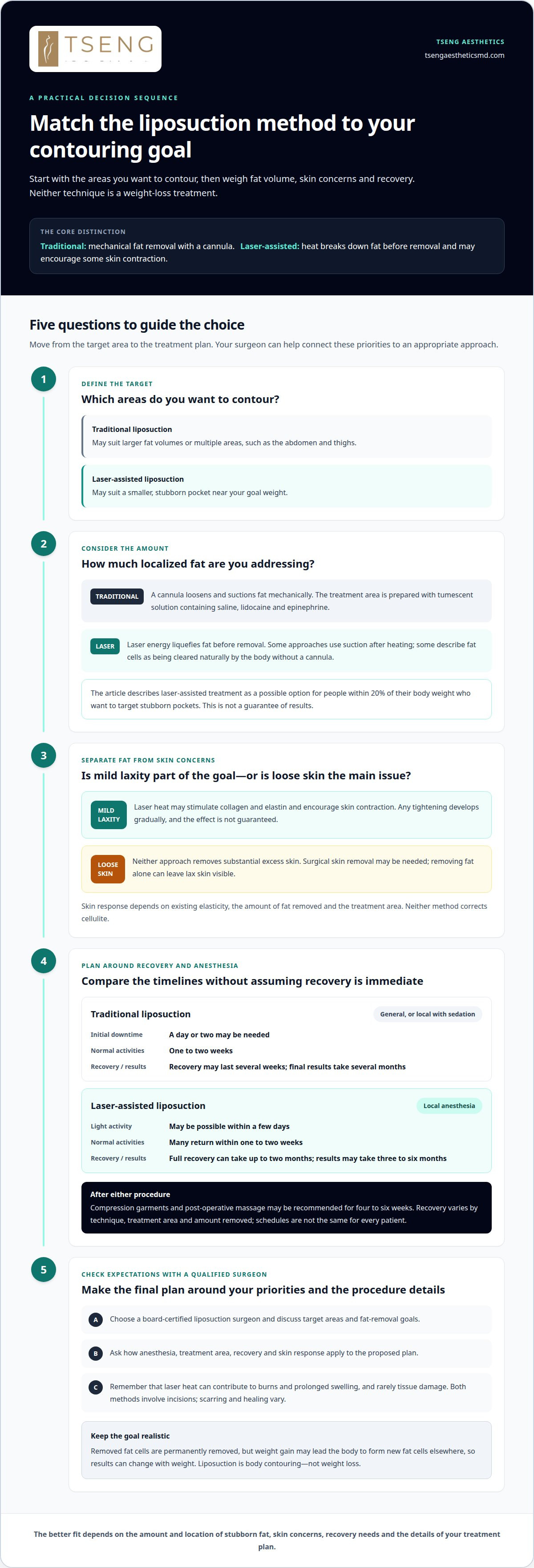
Choosing between laser and traditional liposuction
Choose by matching the technique to the treatment area, fat-removal goal, skin condition, and anesthesia plan. For a small, stubborn pocket near your goal weight, laser-assisted treatment may fit; larger volumes or multiple areas often favor traditional liposuction.
During a consultation, the surgeon assesses the amount and distribution of fat, tissue elasticity, and the contour you want. Traditional liposuction provides tactile feedback as the surgeon moves a cannula, helping guide sculpting across the treatment area. Laser-assisted liposuction applies heat, which can support mild tightening but also carries risks such as burns and prolonged swelling.
- Smaller, targeted area: Laser-assisted liposuction may suit a limited pocket and a goal of mild skin tightening.
- Larger volume or multiple areas: Traditional liposuction can remove larger amounts and shape several regions.
- Significant loose skin: Fat removal alone doesn’t address substantial sagging, so skin removal may be the more relevant approach.
Anesthesia is another practical distinction. Laser liposuction is described as using local anesthesia, while traditional procedures may use general anesthesia or local anesthesia with sedation, especially for larger treatment areas. The planned extent of treatment and the patient’s health inform this choice.
Ask the surgeon to connect each recommendation to a specific goal: which area is being treated, how much fat removal is intended, and whether skin laxity changes the plan. Laser outcomes also depend on the device, energy settings, and operator experience. The clearest choice is the technique whose method and limitations fit your desired contour, not simply the one with the more appealing label.
For a tailored discussion of body-contouring goals, schedule a liposuction consultation and review which technique aligns with the treatment area and your priorities.
Tseng Plastic Surgery: Liposuction
Tseng Plastic Surgery offers liposuction for people considering targeted fat removal and body contouring. After comparing laser-assisted and traditional techniques, discuss your treatment goals, the areas you want addressed, and whether fat removal aligns with your concerns. A consultation can clarify how liposuction relates to your desired contour and which factors shape the approach.
Liposuction is intended to address localized fat, not substantial loose skin or cellulite. If sagging skin is your primary concern, fat removal alone may not address it; the right treatment depends on the concern being treated. A clear conversation about your priorities can help distinguish those goals and set realistic expectations.
If you’re considering liposuction, contact Tseng Plastic Surgery to discuss your goals and next steps.
Make your next step a considered one
A thoughtful decision about laser liposuction vs traditional liposuction starts with a clear picture of what you want to change and what you want to preserve. Consider how a potential contour fits your proportions, daily life, and longer-term goals. This perspective can make a surgical discussion more useful than focusing on a technique’s name alone.
Bring your priorities into the conversation: the area that concerns you, the outcome that would feel harmonious, and your questions about treatment or recovery. A surgeon can assess these details alongside your tissue and overall treatment plan, then explain which approach aligns with your goals. If substantial loose skin is the primary concern, discuss it directly, since fat removal may not address it.
Tseng Plastic Surgery offers liposuction, with a consultation as the next step for discussing your body-contouring priorities and suitable approach. Contact Tseng Plastic Surgery to begin that conversation. You can move forward at a pace that feels right, with a clearer sense of the choices ahead.
Frequently Asked Questions
What is Liposuction?
Liposuction is a surgical procedure that removes targeted fat to reshape specific areas of the body. It’s intended for contouring, not general weight loss, and it doesn’t remove cellulite. For example, someone may consider it for a persistent fat pocket despite stable weight. The treatment plan depends on the areas being addressed and the desired body proportions.
What is Lipo Laser?
Lipo Laser can refer to a nonsurgical treatment using laser energy to reduce small amounts of body fat. It differs from laser-assisted liposuction, which is a surgical procedure. The nonsurgical treatment described here focuses on the abdomen and flanks, with sessions taking around twenty to thirty minutes. Clarifying which procedure is meant helps distinguish these two approaches.
What Does Laser Fat Removal Entail?
Laser fat removal may describe either a nonsurgical Lipo Laser treatment or laser-assisted liposuction, so the planned method matters. Nonsurgical Lipo Laser uses laser treatment for small amounts of fat, while laser-assisted surgery uses heat to break down fat before removal. For example, someone considering abdominal treatment should establish whether the plan involves surgery, anesthesia, and suction.
How Do They Differ?
A comparison of laser liposuction vs traditional liposuction centers on how fat is loosened and removed. Traditional liposuction uses a cannula to loosen and suction fat mechanically; laser-assisted liposuction applies heat to liquefy fat before removal. Nonsurgical Lipo Laser is a separate option for small amounts of fat, not another name for laser-assisted surgery. The distinction helps clarify which procedure fits the intended treatment.
What To Expect Before And After The Procedures?
Before treatment, expect to discuss your goals, the areas you want addressed, your health, and the procedure being considered. Ask how the plan affects anesthesia and recovery, especially if you’re comparing nonsurgical Lipo Laser with surgery. After treatment, follow the specific post-procedure instructions and attend scheduled follow-up care. Swelling can affect how quickly the contour becomes visible, so assess changes over time.
Which Lipo Treatment Is Right For You?
The laser liposuction vs traditional liposuction decision depends on whether you’re seeking surgical contouring or nonsurgical treatment for a small area of fat. Your target area, the amount of fat, skin laxity, and tolerance for surgery help shape the choice. A board-certified surgeon can assess those factors and discuss suitable techniques. If substantial loose skin is your main concern, fat removal alone may not address it.

