Masseter Botox for Face Slimming: Clenching, Tension, and Results
By Tseng Plastic Surgery
A broad lower face doesn’t always come from strong jaw muscles. Masseter Botox for face slimming is most likely to create a visible change when enlarged masseter muscles contribute to facial width. It may do little when bone structure or facial fat is the main cause. Slimming often becomes easier to see around the second month, with results looking more settled around the third.
If you’re considering treatment, it’s natural to want a softer jawline without sacrificing comfortable chewing or a natural smile. Changes develop gradually, and muscle shape, facial structure, and injection placement all matter.
This article explains which face shapes may respond, how clenching and jaw tension relate to treatment, and what to expect as results develop. It also covers possible effects on chewing and smiling, helping you weigh your aesthetic goals alongside everyday comfort.
Key Takeaways
- Facial width linked to prominent masseter muscles is more likely to respond than width shaped mainly by bone or fat.
- Jaw clenching and tension are relevant to treatment planning, including whether nearby muscles should be considered.
- Injection placement matters: unintended effects can influence chewing comfort or smile balance.
- Use the gradual timeline of facial change to set expectations and assess whether the result aligns with your goals.
Will Masseter Botox Work for Your Face Type?
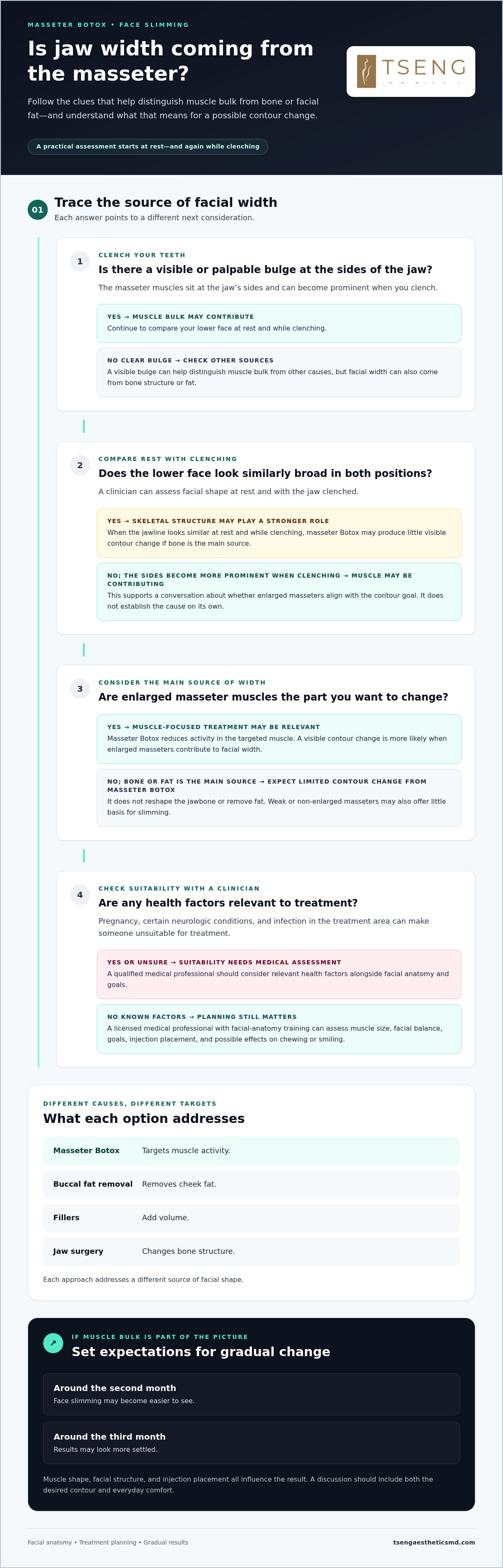
Masseter Botox for face slimming is most relevant when enlarged masseter muscles contribute to a wide lower face. These muscles sit at the jaw’s sides and become prominent when you clench your teeth. A visible bulge during clenching can help distinguish muscle bulk from other sources of width.
Facial width can also come from bone structure or fat. In these cases, relaxing the masseter may produce little visible contour change because it neither alters the jawbone nor removes fat. For example, a broad jawline that looks similar at rest and while clenching may have a stronger skeletal component.
Situation: A person notices bulky jaw muscles and frequent clenching. Action: A qualified medical professional assesses the lower face at rest and while the jaw is clenched. Result: The discussion can focus on whether muscle size, rather than bone or fat, aligns with the desired contour.
Pregnancy, certain neurologic conditions, and infection in the treatment area can make someone unsuitable for treatment. Weak or non-enlarged masseters may also offer little basis for slimming. These factors matter alongside the aesthetic goal, because treatment reduces muscle activity rather than reshaping every part of the lower face.
How does it compare with buccal fat removal, fillers, or jaw surgery? Masseter Botox targets muscle activity; buccal fat removal removes cheek fat, fillers add volume, and jaw surgery changes bone structure. Each approach addresses a different source of facial shape.
How do I choose a qualified provider in the United States? Choose a licensed medical professional with training in facial anatomy who assesses your masseters, facial balance, goals, and relevant health factors. A careful plan should explain injection placement and possible effects on chewing or smiling.
How much does it cost, and what affects the price? Price depends on the treatment plan, amount used, and whether additional areas are treated. Contact the office for pricing.
How much Botox is typically used per masseter? There isn’t one amount for every face. Muscle size, strength, and the desired degree of contouring guide the individualized dose.
What should I expect during and after an appointment? Expect an assessment, a discussion of goals and risks, and injections planned for the masseter muscles. Follow the aftercare instructions provided for your treatment.
Jaw clenching, teeth grinding, and tension
Clenching during work or grinding during sleep can leave the masseter muscles feeling tight and overworked. These muscles help close the jaw, so repeated force may contribute to jaw fatigue or tenderness. Masseter Botox reduces activity in the targeted muscle; it doesn’t remove the habit or identify every cause of facial pain.
For example, someone who wakes with jaw tightness could note when symptoms occur, which side feels more strained, and whether chewing worsens the discomfort. That record gives a clinician useful context alongside an assessment of the masseters. A visible or palpable muscle bulge during clenching can help connect the treatment area with the symptom pattern.
Jaw tension may begin easing during the first week after treatment. The timing and degree of change can vary, so record symptoms before treatment and compare them afterward. If the jaw feels less tense but headaches emerge, the temporalis muscle may also be relevant. In some patients, treating the temporalis as well may help avoid replacing jaw tension with headaches.
Situation: A person clenches during the day and reports tightness near the jaw. Action: The clinician assesses the masseter and discusses the clenching pattern before planning treatment. Result: Reduced masseter activity may ease tension while providing a specific symptom to track.
Situation: Another person grinds their teeth during sleep and has morning jaw soreness. Action: They describe when and where the soreness occurs during assessment, including any headache pattern. Result: The discussion can distinguish a muscle-focused approach from concerns that need separate attention.
Use practical observations to make follow-up more precise:
- Note whether tightness appears on one side or both.
- Track morning soreness, daytime clenching, and headache changes.
- Describe whether chewing brings on discomfort or fatigue.
These details help relate bruxism symptoms to muscle activity without assuming that every case of teeth grinding has the same cause. In complex cases where clenching is linked to structural bite issues or significant dental wear, oral surgery and rehabilitation specialists such as Dr Samintharaj Kumar can help determine whether comprehensive dental treatment is appropriate.
Potential chewing and smile-related downsides
Masseter Botox reduces activity in a muscle used to close the jaw, so chewing can feel different as its effect develops. Around the third week after treatment, some patients notice less pressure when chewing. The change may be subtle during meals, especially with foods that require sustained biting. A sensation of reduced force is different from being unable to chew.
Placement matters for both function and expression. Poorly placed injections can affect chewing or smile balance. If the product diffuses into the nearby risorius muscle, which helps draw the mouth sideways, a smile may appear uneven. For example, one corner of the mouth might move differently during a broad smile. Precise targeting of the masseter helps protect the balance of nearby facial movement.
Situation: Someone notices reduced chewing pressure around the third week. Action: They record when the change occurs, which foods feel different, and whether the effect is on one or both sides. Result: Those details help describe the functional change clearly during follow-up.
A headache also deserves attention in context. If jaw tension eases but headaches appear or change, note their timing and location rather than assuming the cause. The temporalis muscle, which also helps close the jaw, may be considered in treatment planning for some patients. Recording jaw symptoms and headaches before treatment provides a useful comparison afterward.
For a practical check, compare familiar movements before and after treatment:
- Chew a usual meal and notice any change in pressure or fatigue.
- Smile naturally, then broadly, and observe whether both sides move evenly.
- Record new headaches, their location, and their relationship to jaw tension.
Situation: A person sees an uneven smile after treatment. Action: They document the movement and when it occurs, then share those observations with the treating clinician. Result: The specific pattern can help assess whether the risorius or another movement is involved.
These observations help distinguish a change in muscle strength from a change in facial movement, keeping aesthetic goals aligned with everyday function.
Expected face-slimming results
Masseter Botox changes facial contour gradually as activity in the treated muscle decreases. Visible slimming often becomes easier to see around the second month, while results often look most settled around the third month. A narrower lower face is most relevant when masseter bulk contributes to width, rather than bone structure or facial fat.
Situation: Someone hopes to see a sharper jawline immediately after treatment. Action: They compare baseline photos with later images taken from similar angles and in consistent lighting. Result: Changes are easier to assess over time than by judging the jaw day to day. Around the second month, muscle-related contour changes may be more apparent.
Results often last about three to four months. Maintenance timing depends on how muscle activity and facial contour change over time; there isn’t one schedule for everyone. More than one treatment may be needed to achieve optimal results, so the plan can account for a gradual response rather than assuming one appointment completes the process.
Situation: A person sees modest contour change at the second-month mark. Action: They review the result near the third month, when the appearance often looks more settled. Result: That comparison provides a clearer basis for discussing whether the degree of refinement matches their goal.
Track the same details at each stage: lower-face width at rest, muscle prominence during clenching, and overall facial balance. For example, a slimmer jaw can look different depending on cheek volume and chin proportions. The goal is not simply to reduce width, but to consider how a change at the jaw relates to the face as a whole.
For a personalized discussion of facial contour and treatment goals, explore facial aesthetic options.
Tseng Plastic Surgery: Facelift
Tseng Plastic Surgery offers facelift options for people whose concerns extend beyond muscle-related jaw width to changes in facial or neck appearance. Masseter Botox targets muscle activity, while a facelift or minimal invasive preservation face and neck lift addresses a different aesthetic goal. A personalized discussion can help clarify which concern matters most and whether a surgical approach aligns with the change you envision.
Consider this next step if your priorities involve broader facial rejuvenation rather than a slimmer jawline alone. Bring clear goals, such as addressing the face and neck together, so the conversation can focus on an appropriate approach without treating every concern as a muscle issue.
For a thoughtful discussion of your facial goals, contact Tseng Plastic Surgery.
Choose a next step that fits your goals
Deciding whether masseter Botox for face slimming fits your goals starts with identifying what you want to change: jaw muscle prominence, facial balance, or broader signs of aging. Your facial anatomy and priorities guide which approach is most relevant, so consider the effect you hope to see alongside comfort and natural expression.
If your goals extend beyond the jaw muscles, a conversation about facial rejuvenation can help clarify the options. Tseng Plastic Surgery offers facelift and minimal invasive preservation face and neck lift procedures, as well as liposuction. These address different concerns, so the discussion can focus on the areas you want to refine rather than assuming one treatment suits every goal.
Bring your questions and describe the changes that matter most to you. Contact Tseng Plastic Surgery to begin a thoughtful conversation about your aesthetic goals. A well-considered next step can help you move forward with greater clarity and confidence.
Frequently Asked Questions
How does masseter Botox slim the face, and how long does it take to see results?
It relaxes the masseter muscles, which can gradually reduce muscle-related width along the lower face. Visible contour changes often become easier to notice around the second month and look more settled around the third. For a practical comparison, take a relaxed, front-facing photo before treatment and later photos in similar lighting and from the same angle.
Who is a good candidate for masseter Botox for facial slimming?
Someone with prominent masseter muscles contributing to lower-face width may be a candidate. A clinician can assess the jaw at rest and during clenching, then compare muscle prominence with the person’s desired contour. Width caused mainly by bone or facial fat is less likely to change visibly. Pregnancy, certain neurologic conditions, and infection in the treatment area affect suitability.
What are the risks and side effects of masseter Botox in the jaw?
Possible functional effects include reduced chewing pressure or changes in smile balance, particularly if injection placement is poor or product reaches a nearby muscle. Jaw tension may also change, so note any new headache pattern rather than assuming it has the same cause as earlier discomfort. Before treatment, describe your usual chewing comfort, smile movement, and jaw symptoms to support a tailored plan.
Can masseter Botox cause chewing weakness, facial asymmetry, or a sunken appearance?
Chewing can feel weaker or less forceful as the masseter becomes less active, and injection placement can affect smile balance. The treatment targets muscle activity; it doesn’t remove cheek fat or change jawbone structure. A hollow or sunken look isn’t inevitable, but facial proportions and the amount of muscle contributing to width matter. Discuss your desired contour and existing facial balance before treatment.
Who should avoid masseter Botox, including people who are pregnant or breastfeeding?
People who are pregnant, have certain neurologic conditions, or have an infection where injections would be placed may not be suitable candidates. Someone without strong or enlarged masseter muscles may also have little basis for muscle-related slimming. Breastfeeding is a separate consideration to disclose during medical assessment, alongside medications, health conditions, and treatment goals.

