Revision Facelift Specialist: How to Choose with Confidence
By Tseng Plastic Surgery
What if the most important first step after a facelift concern isn’t choosing another operation, but understanding what’s causing it? Finding a revision facelift specialist can feel difficult when changes may relate to the original surgery, ongoing aging, or both. The thought of looking unnatural again can weigh heavily.
Those concerns deserve a careful, individualized assessment. A thoughtful conversation can help clarify what you’re noticing, what may be addressed, and what another procedure could involve. The aim is not to promise perfection, but to consider an appropriate path with your goals and wellbeing in view.
This article explains what a revision facelift assessment may involve, which questions can help you understand a surgeon’s experience and approach, and how to discuss the result you hope to achieve. At Tseng Plastic Surgery, Dr. Mark H. Tseng brings more than 20 years in practice to facial rejuvenation care, including facelift surgery and minimal invasive preservation face and neck lifts. Understanding your options starts with listening closely and considering the face as a whole.
Key Takeaways
- Separate changes that may stem from the previous facelift from those associated with aging before considering another procedure.
- A thorough assessment can consider facial structure, skin, scars, symmetry, surgical history, timing, and healing.
- Further surgery, another facial rejuvenation approach, or waiting may each be worth discussing, depending on your anatomy, health, concerns, and goals.
- Prepare for a consultation by organizing your surgical history and describing in your own words what you hope to address.
- Look for a revision facelift specialist who communicates clearly, assesses your individual concerns, and explains the limits and alternatives of possible treatment.
What Does a Revision Facelift Address, and When Is It Considered?
A revision facelift assessment considers whether further facial surgery may be appropriate after a person has already had a facelift. Unlike a routine facelift consultation, it takes into account how the earlier procedure, healing, and the passage of time may have shaped the current appearance. The assessment does not mean another operation is automatically needed.
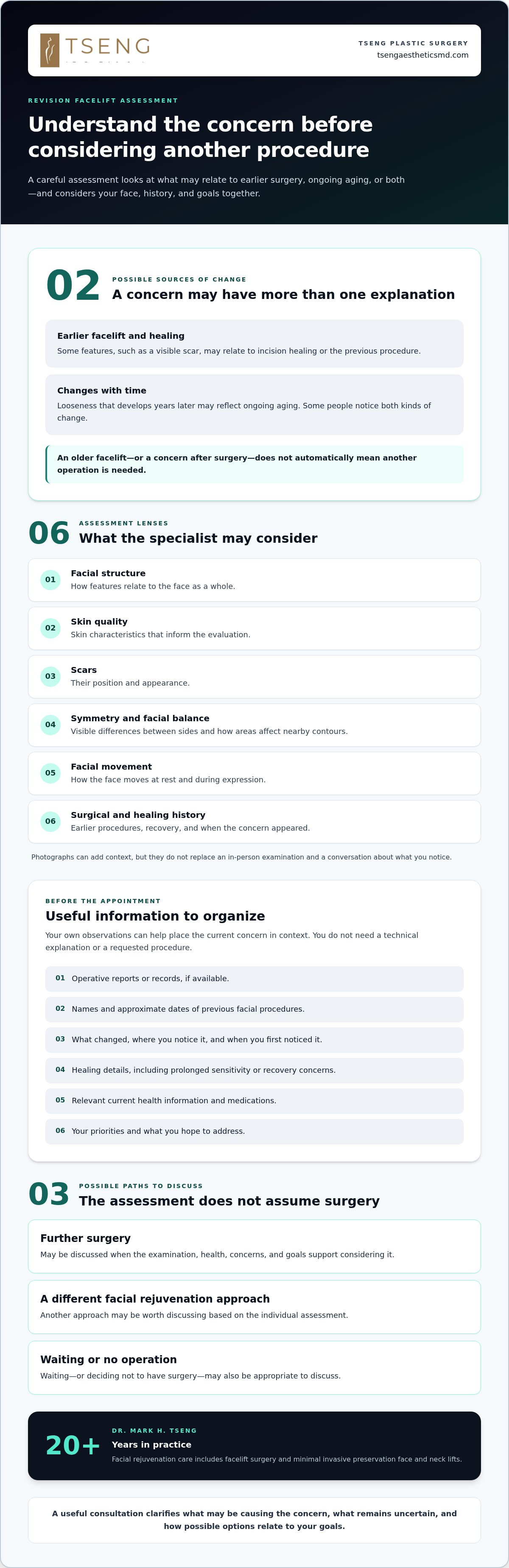
A concern that appears after surgery can have more than one explanation. A visible scar, for example, may relate to incision healing, while looseness that develops years later may reflect ongoing changes with age. Some people notice both. The assessment considers the face as it is now, the person’s history, and the specific change they want to understand.
A general overview of facelift surgery, including different techniques, is available in Facelift (Rhytidectomy). For someone considering further care, the more useful question is personal: what is causing the concern, and what options, if any, make sense for that individual?
Which concerns lead people to seek a revision facelift specialist?
People may seek an assessment because of visible scarring, asymmetry, persistent laxity, or a result that feels unnatural to them. These concerns can occur alone or together. For example, someone may be bothered by both a noticeable scar and a difference in contour between the sides of the face. Describing what feels changed, and where, helps focus the evaluation.
A concern doesn’t establish that surgery is needed. A revision facelift specialist considers the appearance, the history of the prior procedure, and the patient’s priorities before discussing next steps. The purpose is to understand the issue and its context, not to assume that every difference can or should be corrected surgically.
Does an older facelift automatically mean revision surgery?
No. Facial aging continues after a facelift, so someone may later seek renewed rejuvenation without being dissatisfied with the original result. Another person may remain concerned about a feature from the earlier surgery, whether or not aging has also changed the face. These are different motivations, and the time elapsed alone cannot determine whether further surgery is appropriate.
An individualized examination helps clarify the concern, consider the person’s anatomy and overall health, and identify what they hope to change. It also creates space to discuss whether the concern relates to the earlier result, later aging, or both. After that assessment, possible options can be considered. Sometimes the most useful outcome is greater clarity rather than a decision to have an operation.
How a Revision Facelift Specialist Assesses Previous Surgery
A careful assessment starts with your concern and considers it in the context of your face and surgical history. The surgeon may examine facial structure, skin quality, scars, symmetry, and how your face moves at rest and during expression. These details help distinguish a localized issue from a change that affects overall facial balance. Photographs can provide context, but they can’t replace an in-person examination and a conversation about what you notice.
Prior surgery changes the anatomy being assessed. Planning future facial surgery must account for both current features and tissues shaped by the earlier procedure.
For a general explanation of what facelift surgery may involve, the American Society of Plastic Surgeons offers a Facelift Procedure Overview. This broad overview can help frame your questions. An individualized evaluation determines which details of your own experience matter to the discussion.
What information helps assess a previous facelift?
Bring any operative reports or records you have, along with the names and approximate dates of prior facial procedures. If you don’t have records, your recollection is still useful. Describe what changed, when you first noticed it, and what concerns you now. For example, note whether a feature seemed present soon after healing or became more noticeable later.
Include details about healing, such as areas of prolonged sensitivity or concerns discussed during recovery. Share relevant current health information and medications as well. A revision facelift specialist can use this history alongside the examination to understand the sequence of events, rather than judging your present appearance in isolation. You don’t need to arrive with a technical explanation or a requested procedure. Clear observations in your own words are more helpful.
How are scars, facial balance, and tissue changes evaluated?
The examination may consider the position and appearance of scars, skin quality, facial movement, and visible differences between the two sides. The surgeon also considers deeper tissues and how each area relates to the face as a whole. A concern that seems confined to one spot may affect, or be influenced by, nearby contours. Understanding these relationships helps inform a discussion of possible approaches.
There isn’t one technique that suits every situation. A recommendation depends on the concern, examination findings, earlier procedure, health, and priorities. Ask the surgeon to explain what they observe, which details remain uncertain, and how the options relate to your goal. This helps you assess whether the discussion is clear and tailored to your situation rather than based on a fixed plan.
At Tseng Plastic Surgery, Dr. Mark H. Tseng brings over 20 years in practice to facial rejuvenation care, including facelift surgery and minimal invasive preservation face and neck lifts. You can explore the practice’s facial rejuvenation approach as you consider what you’d like to discuss during an individualized assessment.
Revision Facelift Options: Further Surgery, a Different Approach, or No Operation
After assessment, there may be more than one reasonable path. Further surgery, a different form of facial rejuvenation, or waiting can each be appropriate in the right circumstances. The decision depends on what’s causing the concern, facial anatomy, overall health, and what the patient hopes to change. A revision facelift specialist should explain how a proposed option relates to your specific goal, rather than treating another operation as the automatic next step.
No procedure can guarantee a better result, and revision surgery has limitations. Before deciding, discuss the potential benefits, limitations, and material risks. The comparison below offers a framework for that conversation, not a substitute for an individual medical assessment.
| Option | Purpose | Considerations | Why assessment matters |
|---|---|---|---|
| Further surgery | Address a concern that examination suggests may be treated surgically. | Another operation involves uncertainty and may not resolve every concern or produce the exact change imagined. | The surgeon should connect the proposed procedure to the patient’s stated goal and explain benefits, limitations, and material risks. |
| A different facial rejuvenation approach | Consider whether a non-surgical option may be relevant to a selected concern. | Non-surgical treatments can address some goals, but they can’t replace every type of surgical correction. | Assessment helps clarify whether the concern is suited to a non-surgical approach and what that approach can reasonably address. |
| Wait or monitor | Allow time for more clarity when diagnosis, timing, or goals remain uncertain. | Deferring a decision is an option; it doesn’t commit the patient to treatment later. | Discussion can help identify what to observe and when a further evaluation may be useful. |
When might another operation be discussed?
Surgery may enter the conversation if examination identifies a concern that appears amenable to surgical treatment and the proposed change aligns with the patient’s goals. The surgeon should explain why that approach is being considered, what it may and may not address, and what other choices exist. Informed consent includes a clear discussion of expected benefits, limitations, and material risks, without implying that a particular outcome is certain.
When might a different approach or more time be considered?
A non-surgical facial rejuvenation approach may be discussed for selected concerns, with the understanding that it cannot correct every structural or skin-related issue addressed by surgery. If the source of a change is unclear, or the timing of a decision feels uncertain, waiting and reassessing may be reasonable. No alternative should be presented as a guaranteed way to improve a previous result. The choice should reflect the findings, health considerations, and the patient’s priorities.
How to Prepare for a Revision Facelift Consultation
A little preparation can help you leave a consultation with a clearer understanding of your options. Bring any records you have about previous facial procedures, and note what concerns you most now. You don’t need to arrive knowing which operation you want. A revision facelift specialist can assess your concerns with you, while your questions help keep the discussion focused on your priorities.
Questions to bring to a revision facelift consultation
Use these prompts to guide the conversation. You can write down the answers or bring someone you trust to help you remember the discussion.
- How do you interpret my concern? Ask what the examination shows and which findings support the surgeon’s assessment.
- What options could address it? Invite a comparison of further surgery, a different facial rejuvenation approach, or waiting, including what each option cannot change.
- What benefits and risks should I understand? Ask about potential benefits, material risks, limitations, and how these apply to your health and surgical history.
- What might recovery involve? Discuss the recovery expectations relevant to any option being considered, and how follow-up care is approached.
- What would make you recommend waiting? This helps clarify whether more time or information could affect the assessment or decision.
How to set goals and discuss previous results
Describe the changes that matter most in your own words. For example, you might say, “I’m concerned about how this area looks when I smile,” or “I’d like to understand whether this scar can be less noticeable.” Specific observations help distinguish your desired change from a procedure you may have heard about. Share what matters to you, including concerns about scarring, symmetry, or preserving a natural appearance.
It’s reasonable to explain what felt different from your expectations after the earlier procedure, while keeping the conversation focused on what you hope to understand or change now. Ask the surgeon which goals appear realistic and where the limits may be. A thoughtful discussion should leave room for uncertainty and questions, not pressure you to decide during the consultation.
If surgery is among the options discussed, ask how the expected recovery applies to your circumstances. The facelift recovery guide provides general context, while your surgeon can explain what may be relevant to the plan under consideration.
Dr. Mark H. Tseng has been in practice for over 20 years and provides personalized facial rejuvenation care, including facelift surgery and minimal invasive preservation face and neck lifts. The practice’s facial rejuvenation care is relevant context as you consider the questions and goals you’d like to bring to a consultation.
Choosing a Revision Facelift Specialist: A Thoughtful Next Step
Choosing a surgeon to discuss changes after facelift surgery calls for more than comparing techniques or photographs. Look for a careful approach to facial surgery, an assessment that considers your history and goals, and communication that helps you understand your choices. A thoughtful recommendation should explain what may be considered, why it relates to your concern, and what its limits may be.
What signals a careful, patient-centered specialist?
Notice whether the surgeon listens to your account and explains the examination findings in language you can follow. A useful discussion leaves room for questions and considers more than one possible path, including no operation. You should come away with a clearer understanding of relevant risks and limitations, not a promise of a particular result.
As you consider your consultation, reflect on whether:
- The surgeon explains how your stated concern relates to the examination.
- Options are discussed in relation to your anatomy, health, and priorities, rather than presented as a fixed plan.
- Potential benefits, limitations, and material risks are addressed plainly.
- Your questions are welcomed, and you have space to consider the information before deciding.
These are not a scorecard for predicting an outcome. They can help you assess whether the conversation supports informed decision-making. Trust develops through clear explanations and shared understanding, not certainty about what surgery can achieve.
Discuss your facial rejuvenation goals with Dr. Tseng
At Tseng Plastic Surgery, Dr. Mark H. Tseng has been in practice for over 20 years. The practice offers facelift surgery and minimal invasive preservation face and neck lifts as part of its facial rejuvenation care, with a focus on personalized attention and natural-looking, balanced results. This experience and approach provide context for a discussion of your goals, but they don’t establish a particular revision outcome or guarantee that an operation is right for you.
Consider describing the change you hope to address, what matters most to you, and what you want to preserve about your appearance. An individualized conversation can explore whether a facial rejuvenation option fits your needs, what its limitations may be, and whether taking more time would serve you better. You’re entitled to understand the reasoning behind a recommendation and make your decision at your own pace.
If you’re ready to discuss your facial rejuvenation goals, schedule a conversation with Tseng Plastic Surgery. A considered next step begins with your concerns, a careful assessment, and an open exchange about what may be appropriate.
Take the Next Step at Your Own Pace
You don’t need to arrive at a final decision before beginning a conversation. A useful next step may simply be identifying the change you most want to understand and the question that would help you feel more informed. From there, you can consider whether the discussion gives you a clear picture of possible paths, their limits, and what matters most to you.
Choosing a revision facelift specialist is ultimately about finding an approach that respects both the complexity of prior surgery and your individual vision. Give yourself room to reflect, ask follow-up questions, and decide when you have enough information to move forward. The right pace is one that allows you to feel heard and considered.
If you’d like to explore your goals for facial rejuvenation, discuss your facial rejuvenation goals with Dr. Tseng. A thoughtful conversation can be a measured first step toward deciding what feels right for you.
Frequently Asked Questions
Is a revision facelift more complicated than a first facelift?
It can be more complex, but the degree varies with the previous procedure, healing, and the concern being assessed. Earlier surgery may have changed the tissues and left scars that affect planning. A revision facelift specialist considers those factors alongside your health and goals rather than assuming every second procedure presents the same challenges. Ask the surgeon to explain which details of your history influence the options being discussed.
Can a revision facelift correct scars or an uneven result?
It may be possible to address some scars or asymmetry, but whether surgery is appropriate depends on their location, characteristics, and effect on facial balance. For example, a visible scar and uneven contour may have different causes and call for different discussions. An examination can clarify what might be changed and what may remain. No correction can guarantee perfect symmetry or erase every scar.
How long should I wait before considering a revision facelift?
There isn’t one waiting period that applies to everyone. Appropriate timing depends on the original surgery, your healing, the concern, and whether the appearance is still changing. If you’re unsure whether a feature is part of healing or a lasting change, ask your treating surgeon how and when it should be reassessed. A consultation can help clarify timing without obligating you to schedule another procedure.
What should I bring to a revision facelift consultation?
Bring a concise timeline of your procedure and healing, plus any records or photographs you already have that show changes over time. A list of medications, allergies, and relevant health conditions can help make the discussion more complete. Write down your main questions and describe which features matter most to you. These details can help the surgeon understand your perspective and keep the conversation focused.
Will a revision facelift make me look like I did before my first surgery?
That can’t be promised. Facial appearance changes with age, and a further procedure may not recreate an earlier version of your face or reverse every effect of the first surgery. A more useful goal is to describe the specific feature you hope to address and discuss what may be achievable while preserving your natural character. Ask the surgeon to clarify where expectations and surgical limitations may differ.
Can non-surgical treatments replace revision facelift surgery?
Sometimes a non-surgical treatment may be relevant to a selected concern, but it isn’t a substitute for every change that may be considered for surgery. For example, a treatment that improves one aspect of facial appearance may not address loose skin or other structural concerns. The right comparison depends on the finding and your priorities. Ask what each option can realistically address, how it differs, and what it cannot change.
What risks should I discuss before revision facelift surgery?
Ask the surgeon to explain risks specific to the proposed procedure and your health, as well as how prior surgery may affect them. Discussion may include bleeding, infection, anesthesia-related complications, changes in sensation, visible scarring, asymmetry, healing concerns, and the possibility that you may not be satisfied with the result. Ask how these risks are weighed against potential benefits and what care or follow-up would involve if a concern arises.

