Scar creams for surgical scars: comparing silicone and onion extract
By Tseng Plastic Surgery
Over-the-counter treatments can improve the appearance of surgical scars, but they can’t remove them completely. Among the best scar creams for surgical scars, silicone products are a more evidence-supported choice than onion extract, whose effectiveness remains uncertain. Consistent use matters: daily treatment for at least 8 to 12 weeks is generally needed to see significant improvement in new scars.
It’s understandable to want a surgical scar to fade as much as possible. The right approach depends on what you hope to improve, how the scar is healing, and whether topical treatment is appropriate. This guide compares silicone with onion extract, explains what to expect from over-the-counter products, and reviews options that may suit postsurgical scars. You’ll also find practical criteria for comparing products and guidance on when topical care may not be enough.
Key Takeaways
- Understand why silicone is generally the stronger-supported topical option, while evidence for onion extract remains limited.
- Learn what to watch for when using over-the-counter scar treatments and how to respond if a product irritates your skin.
- Use dermatologist rankings as one way to compare products, while weighing the formula and format against your scar-care needs.
- Set realistic expectations: topical care may improve a surgical scar’s appearance, but it cannot erase the scar completely.
Is silicone more effective than onion extract for scars?
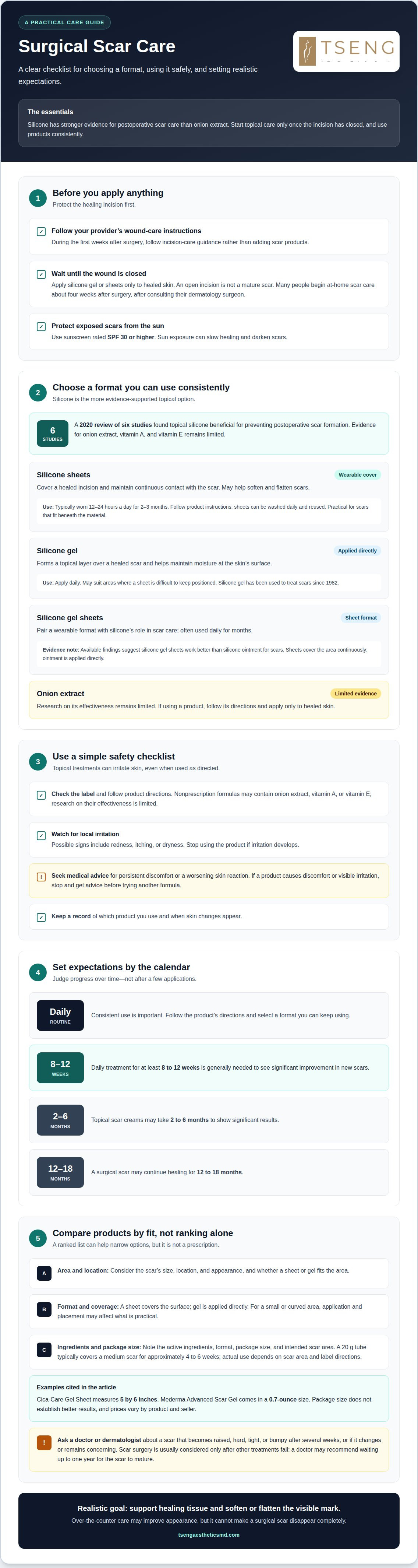
Silicone has stronger support than onion extract for postoperative scar care. During the first weeks after surgery, follow your provider’s wound-care instructions; use scar products only after the wound closes. Protect exposed scars with sunscreen rated SPF 30 or higher, since sun exposure can slow healing and darken scars.
Postoperative Scar Prevention Evidence
A 2020 review of six studies found topical silicone beneficial for preventing postoperative scar formation. That gives silicone stronger support than onion extract, vitamin A, or vitamin E, for which research remains limited. Silicone helps keep scars moisturized and may make them softer and flatter. It can improve appearance, but it cannot make a surgical scar disappear completely.
Silicone Scar Sheets
Silicone sheets cover a healed incision and provide continuous contact with the scar. They’re typically worn 12 to 24 hours a day for two to three months. Once the wound has closed, apply the sheet over the scar, following its product instructions. Sheets can be washed daily and reused, making them a practical option for scars that fit beneath the material.
Silicone Scar Gels
Silicone gel forms a topical layer over a healed surgical scar, without requiring a sheet to stay in place. It can be applied daily and helps maintain moisture at the skin’s surface. This format may suit scars in areas where a sheet is difficult to keep positioned. Silicone gel has been used to treat scars since 1982.
Silicone Gel Sheets and Ointments
Silicone gel sheets pair a wearable format with silicone’s role in scar care, and are often used daily for months. Available findings suggest silicone gel sheets work better than silicone ointment for scars. Both are topical options, but sheets cover the area continuously while ointment is applied directly. Neither can completely remove a surgical scar.
| Option | Evidence | Use |
|---|---|---|
| Silicone sheets | May soften and flatten scars | Wear daily; wash and reuse |
| Silicone gel | Supports moisture | Apply daily |
| Onion extract | Research remains limited | Follow product directions |
Choose a format you can use consistently after the incision closes.
Common side effects of OTC scar treatments
Topical scar products can cause local irritation, including redness, itching, or dryness. Formulas vary: nonprescription options may contain onion extract, vitamin A, or vitamin E, but research on their effectiveness is limited. Apply products only to healed skin, follow the label, and stop if irritation develops. Seek medical advice for persistent discomfort or a worsening skin reaction.
Timing matters after surgery. In the first weeks, follow your healthcare provider’s incision-care instructions rather than adding scar products. Many people begin at-home scar care about four weeks after surgery, after consulting their dermatology surgeon. The wound must be closed before applying silicone gel or sheets; an open incision is not a mature scar.
Use consistency, not immediate change, to judge an OTC treatment. Daily use for at least 8 to 12 weeks is generally needed to see significant improvement in new scars. Topical scar creams may take 2 to 6 months to show significant results, so assess progress over time rather than after a few applications. A surgical scar may continue healing for 12 to 18 months.
A doctor or dermatologist can assess a scar that becomes raised, hard, tight, or bumpy after several weeks, particularly if it remains concerning as healing continues. Raised scars and keloids are common targets of medical scar treatments. Scar surgery is usually considered only after other treatments fail, and a doctor may recommend waiting up to one year for the scar to mature.
During treatment, record which product you use and when skin changes appear. If application causes discomfort or visible irritation, stop using the product and seek medical advice before trying another formula. Over-the-counter care may improve a scar’s appearance, but surgical scars don’t disappear completely. Treatment aims to support healing tissue and soften or flatten the visible mark.
Dermatologist-ranked over-the-counter scar products
U.S. News surveyed 129 U.S. dermatologists to rank scar creams and treatments. A ranking can help narrow options, but it doesn’t establish which topical formula suits every incision. Consider the scar’s size, location, appearance, and whether a sheet or gel fits the area. The listed products are examples to compare, not a prescription for every scar.
Format matters for coverage. Cica-Care Gel Sheet measures 5 by 6 inches, while Mederma Advanced Scar Gel comes in a 0.7-ounce size. A silicone sheet offers a surface covering; a gel can be applied directly to a healed scar. For a small or curved area, application and placement may influence which form is practical.
Ingredients matter. Silicone is used in scar-care products, while some nonprescription formulas contain onion extract, vitamin A, or vitamin E. Research on the effectiveness of those ingredients is limited. A dermatologist can assess whether a scar is raised or discolored and discuss suitable topical care. Product rankings don’t replace an assessment, especially when a scar is changing or remains troublesome.
Packaging helps estimate how long a product may last. A 20 g tube typically covers a medium scar for approximately 4 to 6 weeks. Actual use depends on the scar’s area and how much product the label directs you to apply. Compare package size with the treatment period you expect, rather than assuming a larger package means better results. Prices vary by product and seller, so compare current listings without treating cost as proof of effectiveness.
For a useful comparison, note each product’s active ingredients, format, package size, and intended scar area. Consider how consistently you can use it: a sheet must stay in place, while gel needs direct application. Use products only on closed skin, follow label directions, and discuss persistent discoloration or raised tissue with a dermatologist.
Scar creams recommended for postsurgical scars
For a healed incision, choose a topical product based on its ingredients, format, and your care goals. Mederma PM Intensive Overnight Scar Cream contains 2% dimethicone. That specific ingredient makes it a product to consider when comparing formulas, but no cream can completely remove a surgical scar. Results depend on consistent use while the scar continues healing.
Silicone products remain a relevant option for postsurgical scars because evidence supports their role in scar care. Gel is applied directly, while a sheet covers the scar’s surface. Mederma PM comes as a cream, which may suit someone who prefers applying a product rather than wearing a sheet overnight. Use it only on closed skin and follow the product label.
Use OTC scar creams once or twice daily, according to product directions. Consistent daily use for at least 8 to 12 weeks is generally needed to see significant improvement in new scars; topical creams may take 2 to 6 months to show significant results. These timelines describe gradual change, not complete removal. A scar may continue healing for 12 to 18 months after skin surgery.
Care extends beyond the cream. During the first weeks after surgery, follow the healthcare provider’s wound-care instructions. Once the incision is closed, protect exposed scars from sunlight with sunscreen rated SPF 30 or higher. Sun exposure can slow healing and make discoloration more noticeable, so sunscreen supports the overall care routine.
Choose a product you can use consistently, follow its directions, and observe how the scar changes over time. If a scar becomes raised, hard, or persistently concerning, a doctor can assess its healing and discuss whether topical care is still appropriate. The key takeaway: scar creams may improve appearance, but the realistic goal is improvement, not erasure.
Tseng Plastic Surgery: Non-surgical Facelift
Tseng Plastic Surgery offers a Non-Surgical Facelift for people considering facial rejuvenation, a different goal from treating a surgical scar. Scar creams focus on the scar’s appearance; they don’t address broader facial concerns. If you’re also considering facial rejuvenation, a Non-Surgical Facelift may be relevant to discuss. It isn’t a scar treatment, and topical products remain the focus of the guidance above.
The right next step depends on your concern: a raised or changing scar calls for medical evaluation, while facial rejuvenation is a separate consideration. Keeping those goals distinct helps you choose an appropriate approach for each.
For a conversation about facial rejuvenation, contact Tseng Plastic Surgery.
Choose the next step that fits your goals
Scar care and aesthetic treatment address different concerns, so choose your next step based on what you want to change. The best scar creams for surgical scars may support a focused topical-care routine, while other procedures address broader goals involving facial appearance or body contour. Keeping those aims distinct helps you make a considered choice without expecting one treatment to do everything.
Tseng Plastic Surgery offers Facelift and Minimal Invasive Preservation Face and Neck Lift procedures for facial rejuvenation, as well as Liposuction for body contouring. These options are not scar creams or substitutes for scar care. They may be relevant if your goals extend beyond a surgical scar’s appearance; a consultation can help clarify which direction fits your priorities.
Take time to identify the concern you want to address and the outcome that matters to you. For a conversation about your aesthetic goals, Contact Tseng Plastic Surgery. A thoughtful next step can begin with a clear understanding of what you want to refine.
Frequently Asked Questions
Can OTC treatments completely remove a scar?
No. Over-the-counter treatments can’t completely remove a surgical scar. They may improve features such as texture, height, or color, but results depend on the scar and the product. For example, a topical treatment may help a raised mark look flatter without changing the line left by the incision. The realistic goal is improvement, not erasure.
How do I avoid scarring?
You can’t always prevent a scar, but careful wound care can support orderly healing. In many cases, surgical planning also helps limit tissue trauma; for individuals managing lower extremity issues or foot pain, resources like frankelfoot.com outline how minimally invasive approaches can minimize visible incisions and recovery discomfort. During healing, follow your surgical team’s instructions, protect the incision as directed, and avoid picking at scabs or pulling at healing skin. Don’t apply scar products to an open incision. Once the wound has closed, discuss suitable scar care and sun protection with your healthcare provider.
How do dermatologists prevent and treat scars?
Dermatologists consider a scar’s type, location, and stage of healing before recommending care. Silicone may help prevent postoperative scar formation; raised scars and keloids may call for other approaches. Options can include pressure dressings, corticosteroid injections, cryosurgery, or, in selected cases, scar surgery after other treatments fail. Each approach targets different scar features.
How well do scar creams work?
Scar creams can improve appearance, but effectiveness depends on ingredients, regular application, and the scar’s characteristics. A topical formula may be more useful for a new, raised mark than for a deep indentation, which cream cannot fill. Compare the product’s active ingredients and directions, and assess gradual changes in color or texture rather than expecting the scar to vanish.
What Causes Scars?
Scars form as the body repairs damaged skin by creating new tissue. A surgical incision, burn, cut, or acne lesion can disrupt the skin’s structure, and the repair process may leave a visible mark. Appearance varies because the injury’s depth and location affect how tissue heals. Some scars remain flat; others become raised or spread beyond the original wound.
What else can I do for scars?
Once a scar is healed and your clinician approves, gentle massage can be part of care: massage for 1 to 2 minutes at a time, 1 to 3 times daily. Camouflage makeup can help a mark blend with natural skin tone; green-tinted makeup may help disguise redness. These measures address comfort or visibility, rather than removing scar tissue.

