What to Expect 1 Week After a Neck Lift and How Long Recovery Takes
By Tseng Plastic Surgery
At one week after a neck lift, swelling, bruising, and tightness can still be noticeable, even as early healing begins to show. Knowing what to expect 1 week after a neck lift can make this stage feel less uncertain: bruising may start to fade, while swelling and a firm or tight sensation often take longer to settle.
It’s natural to hope that a week marks the end of recovery, but healing happens in stages. Swelling and bruising often begin to ease around days 7 to 10, and some people can return to non-strenuous work or daily tasks within 1 to 2 weeks if their surgeon approves. The pace depends on the procedure and how your body heals.
This guide explains what to expect one week after a neck lift, including visible changes and sensations, how tightness may improve, and when daily activities can gradually resume. It also distinguishes early recovery from the longer process of settling into a refined neck contour, which can continue over several months.
Key Takeaways
- At one week, swelling and bruising may still be visible; they often begin to ease around days 7 to 10.
- Returning to non-strenuous work or daily tasks may be possible within 1 to 2 weeks, with the timing guided by your surgeon’s approval.
- Tightness usually eases gradually as swelling settles, so a firm sensation during early recovery doesn’t necessarily reflect the final result.
- Head elevation, gentle movement, and following your postoperative instructions can help you navigate the first week of healing.
First-week swelling and bruising
At 7 days after a neck lift, swelling and bruising are usually still visible, though they may begin to ease. Their extent varies with the procedure and healing; soreness, tightness, and numbness can also remain around the jaw and incisions.
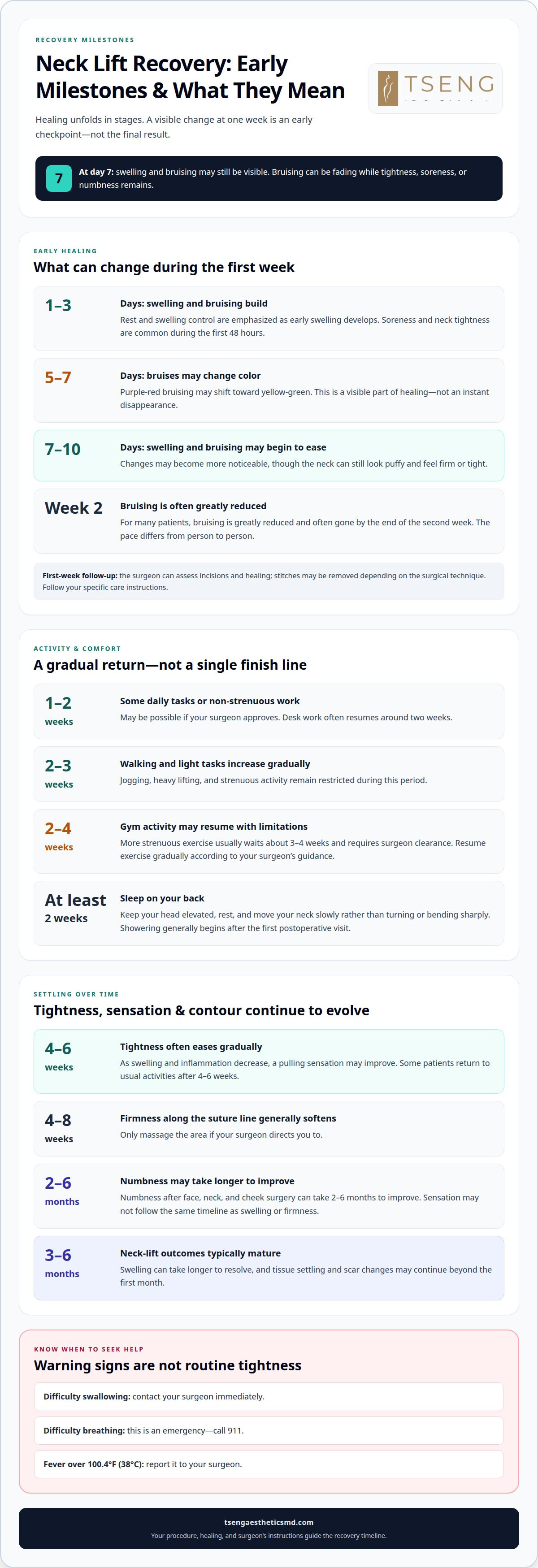
Swelling and bruising commonly build during the first 2 to 3 days, then start settling. By days 7 to 10, changes may become more noticeable, but the neck can still look puffy. Bruises may shift from purple-red to yellow-green around days 5 to 7, a visible change in the healing process rather than an instant disappearance.
Soreness and Tightness
Soreness is tenderness around the treated area, while tightness is a pulling or firm sensation as tissues heal. During the first 48 hours, swelling, soreness, and neck tightness are common; at day 7, some tightness may remain even as bruising fades. These sensations can affect comfort and make early changes in the neck contour harder to judge. Numbness may also accompany healing.
Swelling and Bruising Recovery Timeline
The recovery timeline describes how early swelling and discoloration gradually ease after surgery. Around 7 days, bruising may be fading, while swelling remains visible; both typically begin to subside around days 7 to 10. Bruising is greatly reduced and often gone by the end of week 2 for many patients, but the pace differs. This timeline helps set expectations without treating day 7 as a final result.
During days 1 to 3, rest and swelling control are emphasized as early swelling develops. At the first-week follow-up, the plastic surgeon can assess the incisions and healing; stitches may be removed depending on the surgical technique. Follow the surgeon’s specific care instructions, since incision care and the procedure performed shape the recovery plan. A week marks an early checkpoint, not completion of recovery.
How long does it take to recover from a neck lift?
Recovery takes weeks, and swelling, tissue settling, and scar changes can continue beyond the first month. Showering generally begins after the first postoperative visit. Sleep on your back for at least two weeks, and resume exercise gradually according to your surgeon’s guidance. Readiness to drive depends on alertness, neck movement, and medication effects.
Immediate Care and Discomfort
Immediate care means protecting healing tissues while discomfort settles after surgery. It matters because sudden neck movement or premature exertion can disrupt a comfortable recovery. Keep your head elevated, rest, and move your neck slowly rather than turning or bending sharply. An adult should stay with you for at least 24-48 hours after surgery, and your surgeon’s instructions guide medication and incision care.
Following Postoperative Instructions
Postoperative instructions set the pace for safely returning to daily activities. Follow them closely: during weeks 2 to 3, walking and light tasks can increase gradually, while jogging, heavy lifting, and strenuous activity remain restricted. Gym activity may resume between 2 and 4 weeks with limitations; more strenuous exercise usually waits about 3 to 4 weeks and requires surgeon clearance. Desk work often resumes around two weeks.
Follow-Up with the Operating Surgeon
Follow-up visits let the operating surgeon assess healing and respond to concerns. Attend scheduled appointments and report a fever over 100.4°F (38°C), which may indicate infection. Contact the surgeon immediately for difficulty swallowing or breathing; trouble breathing is an emergency, so call 911. These warning signs need prompt attention rather than waiting for the next routine visit.
Ongoing Recovery and Improvement
Ongoing recovery includes gradual changes in comfort, appearance, and final results. Many patients return to usual activities after 4 to 6 weeks, but swelling can take longer to resolve, and neck-lift outcomes typically mature between 3 and 6 months. The surgical timeline depends partly on the procedure and healing. For readers considering facial rejuvenation, explore facelift planning as a separate conversation from postoperative clearance.
Expected timeline for tightness to improve
Neck tightness often eases gradually rather than disappearing at a single point. After facelift surgery, it may improve over 4-6 weeks as swelling and inflammation decrease, and tightness is expected to lessen during the first month. At one week, a pulling sensation can still be part of early healing. Changes in the feeling of the neck may continue as tissues settle.
After platysmaplasty, tightness may be especially noticeable around the neck. Difficulty swallowing is different from ordinary tightness: contact your surgeon immediately if swallowing becomes difficult. Your surgeon can assess the symptom in light of your procedure and healing, rather than relying on a general recovery timeline. Follow your specific postoperative instructions.
Numbness and tingling can make the neck feel unfamiliar even as tightness starts to ease. Sensory nerves reconnect during healing, and numbness after face, neck, and cheek surgery can take 2-6 months to improve. The changing sensation may not follow the same timeline as swelling or firmness, so note changes and discuss them at follow-up.
Firmness along a neck-lift suture line generally softens during postoperative weeks four through eight. This gradual change can affect how tight the area feels and how the face and neck contours appear. A board-certified plastic surgeon can guide care intended to address tightness. Only massage the area if your surgeon directs you to.
Look at the pattern of symptoms, not just how the area feels on a single day, to understand your progress. Tightness that gradually eases over weeks differs from new difficulty swallowing, which requires prompt contact with your surgeon. If tightness persists or changes, note when it occurs and how it affects movement, then share that information at your next review. Healing timelines vary with the procedure and the individual.
What to expect during the first week after a neck lift
The first week of neck lift recovery centers on protecting healing tissues and following the care plan. Knowing what to expect 1 week after neck lift surgery can help you prepare for the practical details: keep your head raised while sleeping, as directed, and move slowly. Avoid sharp turning or bending, which can strain the surgical area.
During days 1 to 3, rest and follow your plastic surgeon’s directions for dressings, medication, and incision care. Use cold compresses around the neck and jawline only as instructed. For the first 5 to 7 days, keep dressings and incision sites dry while showering. Showering can begin after the first postoperative visit, according to your surgeon’s instructions.
A follow-up appointment usually takes place during week one. The surgeon assesses healing and decides whether sutures can be removed; timing depends on the surgical technique. Don’t pull at sutures or dressings yourself. If your care plan includes medication, follow its directions rather than changing doses based on how the area feels.
By days 4 to 7, patients are usually more comfortable, but the neck isn’t ready for unrestricted activity. Around day 7, activity can increase slowly, while bending, lifting, and straining remain restricted. This measured pace protects the healing contour as swelling and bruising continue to change. A smooth appearance takes longer than one week to emerge. For a more individualized sense of what to expect 1 week after neck lift surgery, discuss your own procedure and recovery plan with your surgeon.
Use the first-week visit to clarify upcoming milestones, including suture care and activity limits. For guidance on neck lift planning and recovery, discuss your neck lift goals.
Tseng Plastic Surgery: Minimal invasive preservation face and neck lift
Tseng Plastic Surgery offers a minimally invasive preservation face and neck lift for people considering surgical refinement of the face and neck. If you’re weighing surgery, a consultation is a natural next step to discuss your goals, the procedure, and recovery. The right approach depends on your concerns, anatomy, and desired changes; an informed discussion helps shape a realistic treatment plan.
Questions about swelling, tightness, or activity after surgery can be part of that conversation. Understanding the expected healing process before deciding can help you prepare for recovery and know what follow-up involves. Contact Tseng Plastic Surgery to discuss whether a face and neck lift aligns with your goals.
Make your next decision with clarity
Understanding what to expect one week after a neck lift can help you plan with more confidence, but recovery is only one part of the decision. Your goals, the areas you want to address, and the changes that matter to you all deserve careful discussion before you choose a path.
Tseng Plastic Surgery offers facelift and liposuction procedures alongside face and neck lifts. A conversation can help you explore which option aligns with your priorities and what questions to consider as you plan. There’s no need to rush. Thoughtful decisions begin with a clear understanding of your goals and the available approaches.
Contact Tseng Plastic Surgery to discuss your aesthetic goals and take a considered next step.
Frequently Asked Questions
How long does it typically take to see the final results of a neck tuck?
Neck-lift results typically mature between 3 and 6 months as swelling resolves, tissues settle, and scars soften. Early changes in contour can appear before that point, but the neck’s appearance continues to evolve during healing. A useful way to assess progress is to compare photographs taken under similar lighting and angles over time, rather than judging the result from a single day.
What symptoms are normal one week after a neck lift?
One week after surgery, visible bruising and swelling, tenderness, tightness, or areas of numbness can still occur. Bruising may look yellow-green as it fades rather than keeping its initial color. Consider symptoms alongside how they change over time and your surgeon’s instructions. New difficulty breathing or swallowing is not routine and needs immediate attention.
How long does neck lift recovery take, and when can I return to work?
Recovery happens in stages: non-strenuous work or daily tasks may resume around 1-2 weeks after surgery when the surgeon approves, while usual activities may take 4-6 weeks. Desk work can involve less physical strain than a job requiring lifting or frequent bending. Plan your return around the demands of your work and the activity limits in your postoperative instructions.
When can neck lift stitches or drains be removed?
Drain removal and suture timing depend on the procedure and the surgeon’s postoperative plan. After a neck lift, a drain may be removed on postoperative day 1, while sutures around the scalp line and behind the ears may be removed around day 7. These are clinical steps, not tasks to perform at home. Keep scheduled follow-up appointments so the surgical team can assess healing.
How should I care for neck lift incisions one week after surgery?
Follow the incision-care directions from your surgical team, since dressing and washing instructions depend on your procedure. Surgical dressings and incision sites are commonly kept dry while showering for the first 5-7 days, with showering starting after the first postoperative visit as directed. Protect healing incisions from sun exposure. Sunscreen near them is typically delayed until the surgeon confirms the wounds are closed.
What complications or warning signs can occur one week after a neck lift?
A fever above 100.4°F (38°C) may suggest infection and warrants immediate contact with your surgeon. Difficulty swallowing or breathing also needs immediate contact. If breathing becomes difficult, call 911. These symptoms require prompt attention rather than waiting for a planned appointment. For other changes that concern you, contact your surgical team and describe when the symptom began and how it has changed.

